Showing posts with label China. Show all posts

Friday, September 07, 2007

Lhasa


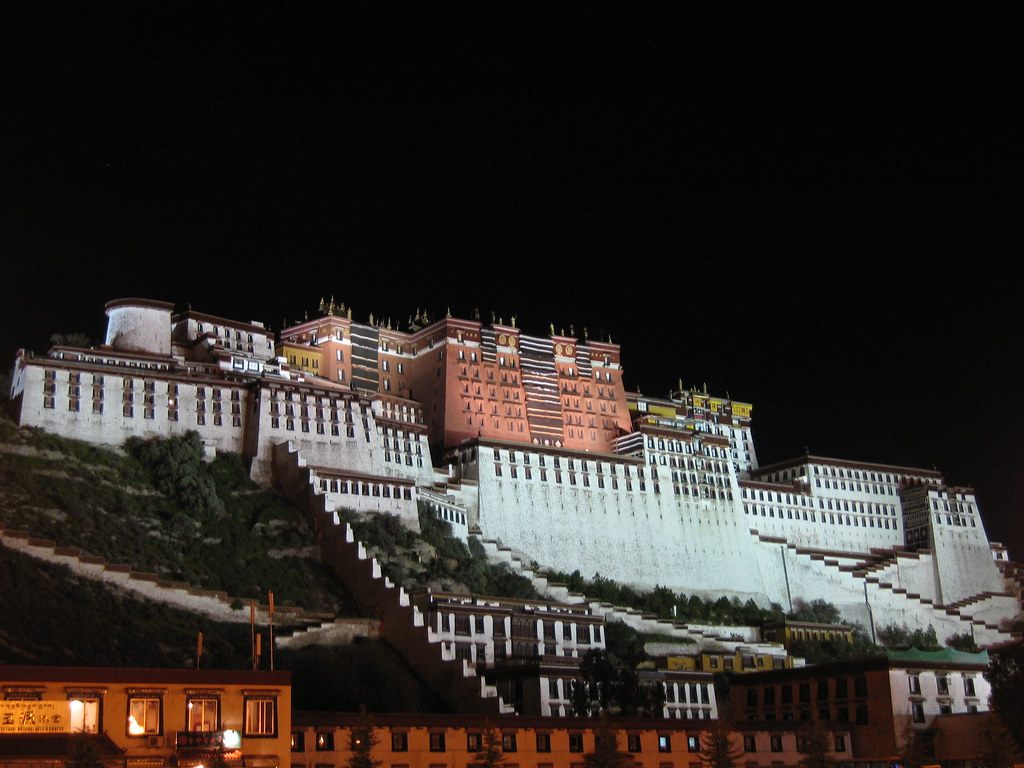
:: Potala Palace by Night ::

Our first impression upon scooting into Lhasa from the train station was 'oh no', this magical place has been turned into another Chinese 'Han' City. Thankfully as we wound our way through the new apartment buildings, hotels and KTV bars we found ourselves arriving into the backpackers area which borders the Old Lhasa we were hoping to see.

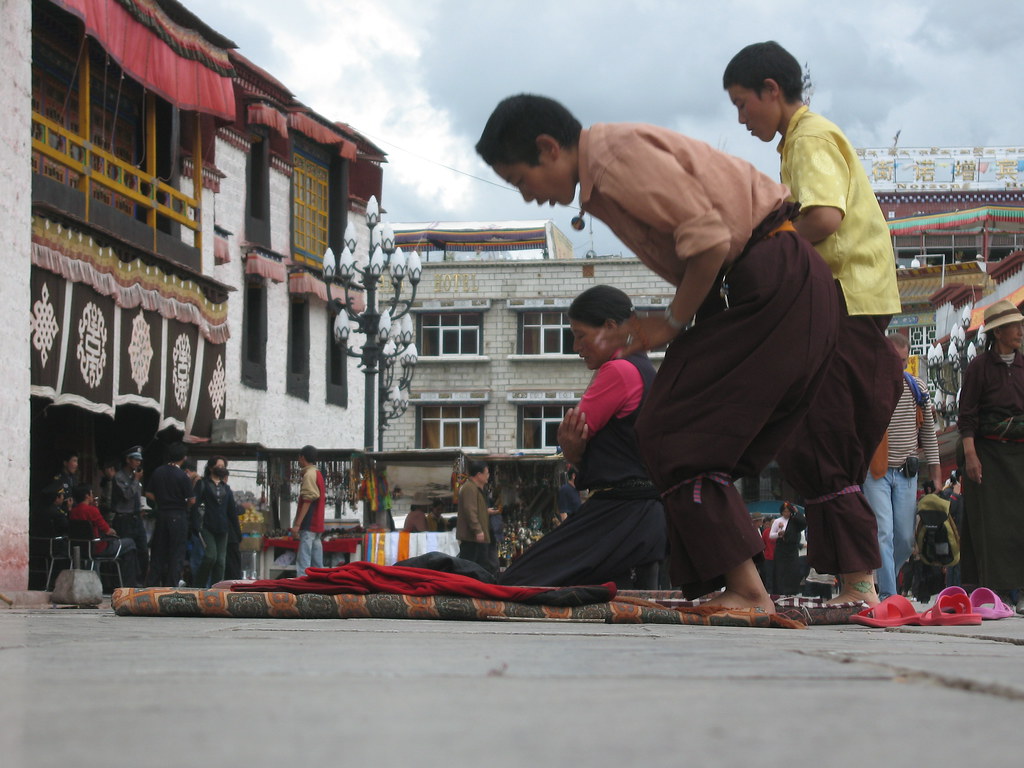
Streets lined with Butchers selling fresh cuts of Yak, Shops full to the ceiling with Yak butter and people on pilgrimages doing rounds of the Monasteries soon filled the backstreets of Old Lhasa.

Potala Palace is obviously on top of everyones list as visitors to the city. Knowing this the local bureaucracy has outdone themselves inventing the most obtuse system to acquire tickets humanly possible. Queuing up the day prior to your visit, before sunrise, passport in hand, you are ushered through into a holding pen to wait until they open the Ticket booking office. Once at the window you obtain a ticket booking receipt for an allocated time which you need to get in the front gate of the Palace the next day.


The Next day you turn up , show your ticket booking slip and enter the palace, only to walk 25 min through the palace to find the actual ticket purchasing booth. Upon location of said booth you surrender your ticket booking slip and passport and (200RMB later) are issued with tickets, 36 hours after commencing the process. Needless to say, the rigmarole was worth is. The palace is an iconic building and seeing the Dalia Lamas tombs inside is remarkable.


:: Debating Monks at Drepung Monastery ::

One of the most unusual things we went to see was the Monks Debating at Drepung Monastery. At 3pm every day the heated, noisy (need sound below) debates get underway. One monk sits on the ground while the other barks points at him, finishing every statement with a loud slap of the hands. It really was quite extraordinary to see and hear.


:: Potala Palace ::

The next leg of our journey takes on the mandatory Jeep trip to the Nepal border. Over 5 days we will bump along dodgy roads, visit Lakes, Monasteries and the highlight, Everest Base Camp. The weather seems to have been stable here recently so signs are good that we will get a good view of the big hill.


Our Next report will be from Kathmandu...stay tuned.... and don't forget to leave comments below if you are so inclined.


Read more...

Lhasa


:: Potala Palace by Night ::

Our first impression upon scooting into Lhasa from the train station was 'oh no', this magical place has been turned into another Chinese 'Han' City. Thankfully as we wound our way through the new apartment buildings, hotels and KTV bars we found ourselves arriving into the backpackers area which borders the Old Lhasa we were hoping to see.

Streets lined with Butchers selling fresh cuts of Yak, Shops full to the ceiling with Yak butter and people on pilgrimages doing rounds of the Monasteries soon filled the backstreets of Old Lhasa.

Potala Palace is obviously on top of everyones list as visitors to the city. Knowing this the local bureaucracy has outdone themselves inventing the most obtuse system to acquire tickets humanly possible. Queuing up the day prior to your visit, before sunrise, passport in hand, you are ushered through into a holding pen to wait until they open the Ticket booking office. Once at the window you obtain a ticket booking receipt for an allocated time which you need to get in the front gate of the Palace the next day.


The Next day you turn up , show your ticket booking slip and enter the palace, only to walk 25 min through the palace to find the actual ticket purchasing booth. Upon location of said booth you surrender your ticket booking slip and passport and (200RMB later) are issued with tickets, 36 hours after commencing the process. Needless to say, the rigmarole was worth is. The palace is an iconic building and seeing the Dalia Lamas tombs inside is remarkable.


:: Debating Monks at Drepung Monastery ::

One of the most unusual things we went to see was the Monks Debating at Drepung Monastery. At 3pm every day the heated, noisy (need sound below) debates get underway. One monk sits on the ground while the other barks points at him, finishing every statement with a loud slap of the hands. It really was quite extraordinary to see and hear.


:: Potala Palace ::

The next leg of our journey takes on the mandatory Jeep trip to the Nepal border. Over 5 days we will bump along dodgy roads, visit Lakes, Monasteries and the highlight, Everest Base Camp. The weather seems to have been stable here recently so signs are good that we will get a good view of the big hill.


Our Next report will be from Kathmandu...stay tuned.... and don't forget to leave comments below if you are so inclined.


Read more...

Wednesday, September 05, 2007

The Highest Train Journey in The World ....


After 45 hours of smooth train riding we have arrived in the Tibetan capital of Lhasa. We spent the first night on the train from Chengdu to Xining on a normal sleeper train before transferring to the swanky "Rocket to the rooftop of the world" in the afternoon. This superdooper train has state of the art engineering and is more spacious and comfortable than your average Chinese sleeper trains. During the train swapping process there was an excited rush of local tourists who barged onto the new train to claim their territory - even though it's seat assigned and we were all to sleep in the same bed number, and thus the same position on the train as the previous night. Once settled it wasn't long before all the equipment and facilities were put through their paces and all the computerised gauges admired. The only complaint on board was that the hot water tank, a vital necessity in the noodle making process, was slow to heat up so there were lots of people wandering around with dry noodles bowls at a loss what to do.

During the first hour on the new train we were subjected to a lengthy description of altitude sickness and every possible affect it could have on the human body. To be honest it went from funny to slightly unsettling. At the end of the health lesson there was a stern announcement of ...."Smoking is very very bad for you - this is a non smoking train" ... yeah right no such luck more like the kind where everyone smokes in between the carriages and waves the smoke towards non existent air vents.


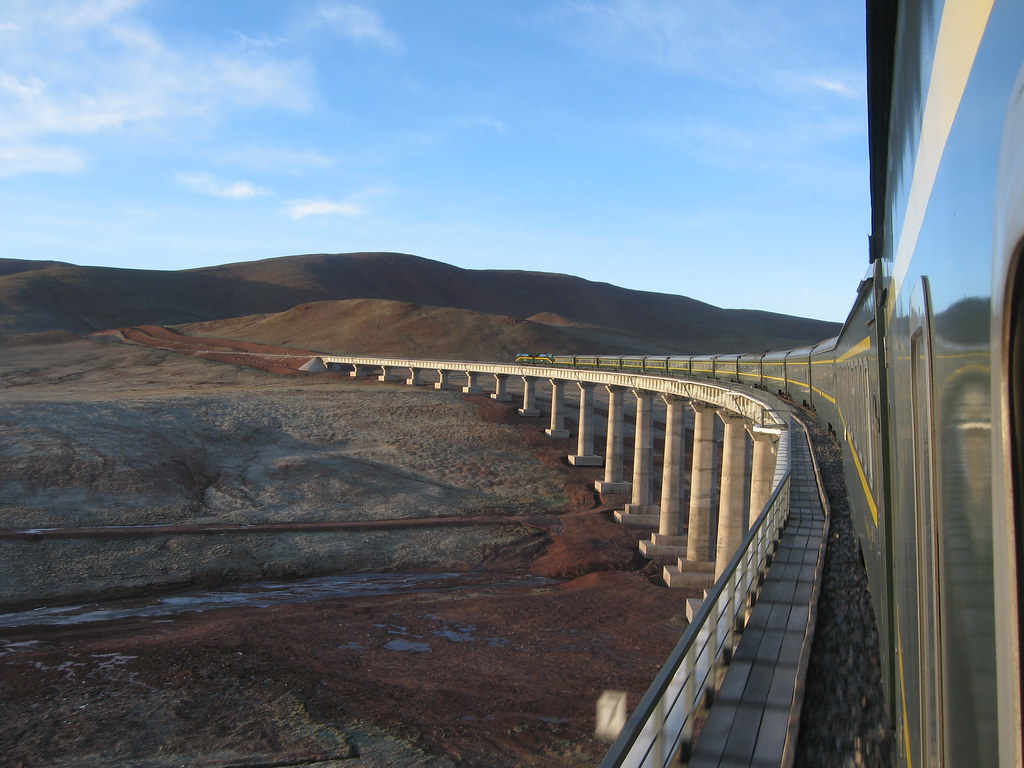
The most interesting section of the train line is between Golmud and Lhasa, it's here that the special diesel engines, capable of operating efficiently at 3-mile-high altitudes, get put to the real test running over track laid on permafrost.


Out the window we saw some incredible scenery, snow capped mountains were plentiful. We also whizzed passed China's largest freshwater lake,
Qinghai Lake. Due to the altitude along this section oxygen is pumped into the train cabins to fend off altitude sickness. Although I'm not sure how much sense this makes if you have to get out and breathe the real air when you arrive in Lhasa.

On the final morning on the train we were all roused at dawn by loud music. The amusing thing about long train journeys in China is that everyone gets up really early in the morning and then discovers that there's nothing to do and ends up going back to bed again. By the last morning some passengers discovered that the oxygen nozzles over each bed were now dispensing air once turned. It spread like wildfire and pretty soon everyone had their nostrils up against the valves taking deep breaths - for it to function correctly a tubed face mask must be connected up! In our carriage a woman "suddenly" became overcome with sickness and was dragged to the next carriage and back again by well wishers, with so many helping and rubbernecking they completely crowded her out so it was hardly surprising that she was overcome and couldn't breathe.

We reached Lhasa earlier than expected and stepped out of our "safe oxygen" chamber and out into the "real air".... everyone quickly forgot about the thin air and in true Chinese style rushed at full speed towards the exit and onto the bus to bags seats.

Read more...

The Highest Train Journey in The World ....


After 45 hours of smooth train riding we have arrived in the Tibetan capital of Lhasa. We spent the first night on the train from Chengdu to Xining on a normal sleeper train before transferring to the swanky "Rocket to the rooftop of the world" in the afternoon. This superdooper train has state of the art engineering and is more spacious and comfortable than your average Chinese sleeper trains. During the train swapping process there was an excited rush of local tourists who barged onto the new train to claim their territory - even though it's seat assigned and we were all to sleep in the same bed number, and thus the same position on the train as the previous night. Once settled it wasn't long before all the equipment and facilities were put through their paces and all the computerised gauges admired. The only complaint on board was that the hot water tank, a vital necessity in the noodle making process, was slow to heat up so there were lots of people wandering around with dry noodles bowls at a loss what to do.

During the first hour on the new train we were subjected to a lengthy description of altitude sickness and every possible affect it could have on the human body. To be honest it went from funny to slightly unsettling. At the end of the health lesson there was a stern announcement of ...."Smoking is very very bad for you - this is a non smoking train" ... yeah right no such luck more like the kind where everyone smokes in between the carriages and waves the smoke towards non existent air vents.


The most interesting section of the train line is between Golmud and Lhasa, it's here that the special diesel engines, capable of operating efficiently at 3-mile-high altitudes, get put to the real test running over track laid on permafrost.


Out the window we saw some incredible scenery, snow capped mountains were plentiful. We also whizzed passed China's largest freshwater lake,
Qinghai Lake. Due to the altitude along this section oxygen is pumped into the train cabins to fend off altitude sickness. Although I'm not sure how much sense this makes if you have to get out and breathe the real air when you arrive in Lhasa.

On the final morning on the train we were all roused at dawn by loud music. The amusing thing about long train journeys in China is that everyone gets up really early in the morning and then discovers that there's nothing to do and ends up going back to bed again. By the last morning some passengers discovered that the oxygen nozzles over each bed were now dispensing air once turned. It spread like wildfire and pretty soon everyone had their nostrils up against the valves taking deep breaths - for it to function correctly a tubed face mask must be connected up! In our carriage a woman "suddenly" became overcome with sickness and was dragged to the next carriage and back again by well wishers, with so many helping and rubbernecking they completely crowded her out so it was hardly surprising that she was overcome and couldn't breathe.

We reached Lhasa earlier than expected and stepped out of our "safe oxygen" chamber and out into the "real air".... everyone quickly forgot about the thin air and in true Chinese style rushed at full speed towards the exit and onto the bus to bags seats.

Read more...

Thursday, August 30, 2007

China's Wild (Sth) West...


:: Lijiang ::

Since departing Myanmar we've spent the month of August high, high up in the Chinese mountains with yaks. Internet has been sparse so once again we're doing a big catchup on all our highlights of the past few weeks. This entry also concludes our time in China; on the 2nd of September, we hop into our bunks and travel on the highest train journey in the world (reaching 5072m) from Chengdu to Lhasa, Tibet.

From Myanmar our route back into China was a flight to the city of Kunming. We'd spent a few days here before so it was a familiar stomping ground. After a sneaky Big Mac we were ready to tackle the tasty noodle soups and skewers served up in the Muslim quarter. After a couple of days of getting back into the swing of using our Mandarin numbers and elbowing our way onto public transport we were ready to head north and tackle the rest of the Yunnan province - and further afield.


:: Dali ::

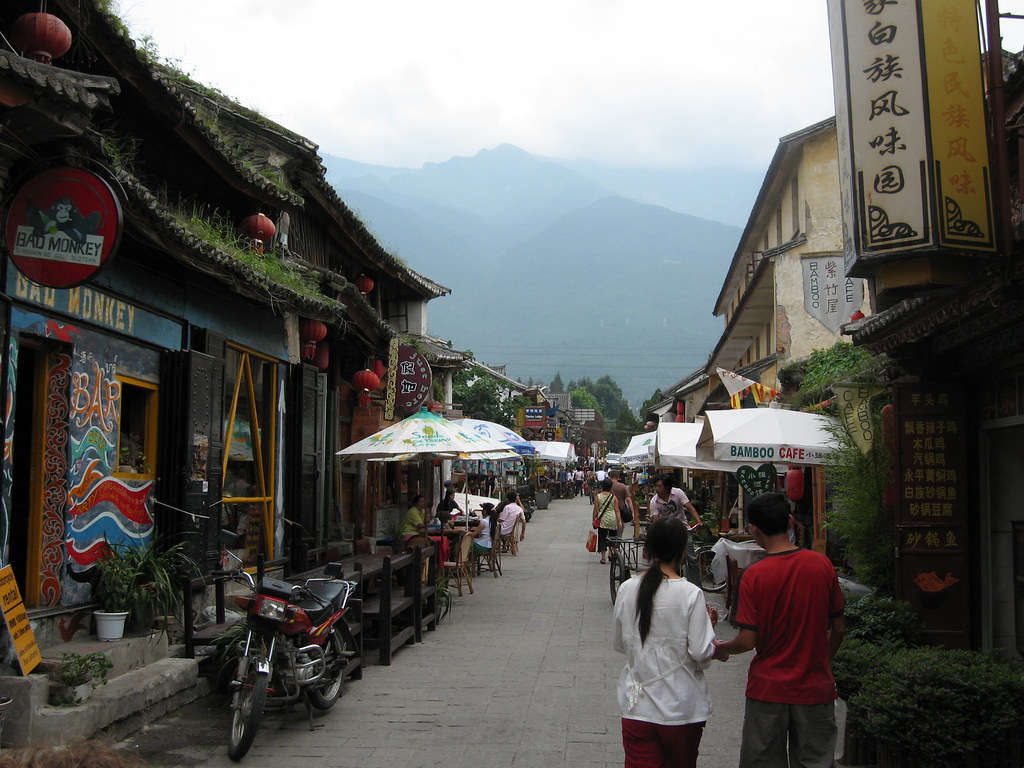
Our first stop was Dali an ancient city that has undergone extensive restoration. Flanked by a mountain, and surrounded by high city walls and a moat this city is a mecca for Chinese tourists. We spent quite a bit of time watching all the ridiculous photo opportunities that people were taking outside the city walls amidst downpours of rain. As a major tourist destination there were no shortage of restaurants to cater for demand. One thing that has shocked us is that since we were here eight months ago the price of meat has risen by a whopping 45%. Luckily we saw this fact on TV otherwise we'd still believe that people were trying to rip us off. Unfortunately we left Dali before realising that one of the most famous "chinglish" signs lived there, it's a famous sign over a squat toilet that simply reads "No shitting in the toilet". Moving north in the full brunt of the region's wet season we reached the picturesque city of Lijiang. Despairingly we reached the labyrinth of the old town as darkness was falling and when there wasn't much room at any of the inns. Arriving under such conditions is always the worst part about backpacking, particularly when the bags are getting heavier and wetter. Adding to the stress were armies of tiny Chinese tourists barging around with umbrellas held at a dangerously eye gouging height - well for me anyhow. Whenever they tried to pass Marcus they bizarrely would attempt to raise their umbrella over and above his! The following morning bathed in sunshine, Lijiang looked a lot more appealing - although the peril of the sun umbrella was still threatening. We managed to find a perfect little traditional Naxi courtyard guesthouse complete with a friendly pregnant owner who when asked when the baby was due replied "it's coming in two days".

The old narrow streets of Lijiang are lined with small waterways and little bridges making it a quirky little place with lots of character. The local ethnic minority in the region is the Naxi people and their Dongba religion and culture, of Tibetan origin, is an important part of the music, paintings and lives of the people. Lijiang is also an extremely popular destination for rich domestic tourists; after dark the bars and restaurants are full of this breed favouring expensive imported Heineken in place of their cheaper local brew. The rowdiness and noise level gradually elevates as rival bars compete in "sing offs" across the canals. Literally one bunch of girls trying to out-sing the other, what's more is that it appears to be the same song that they sing all night, every night.

After getting caught out in the rain badly once, we decided to invest in some very stylish ponchos... and they're not of the normal variety... we got ones that would definitely keep us and our backpacks dry. Designed to cover one's entire body on a motorbike (Marcus's has a see-through bit at the front so the headlights can shine through) this rain attire means business, we left Lijiang as ready for rain as Noah was for the great flood.


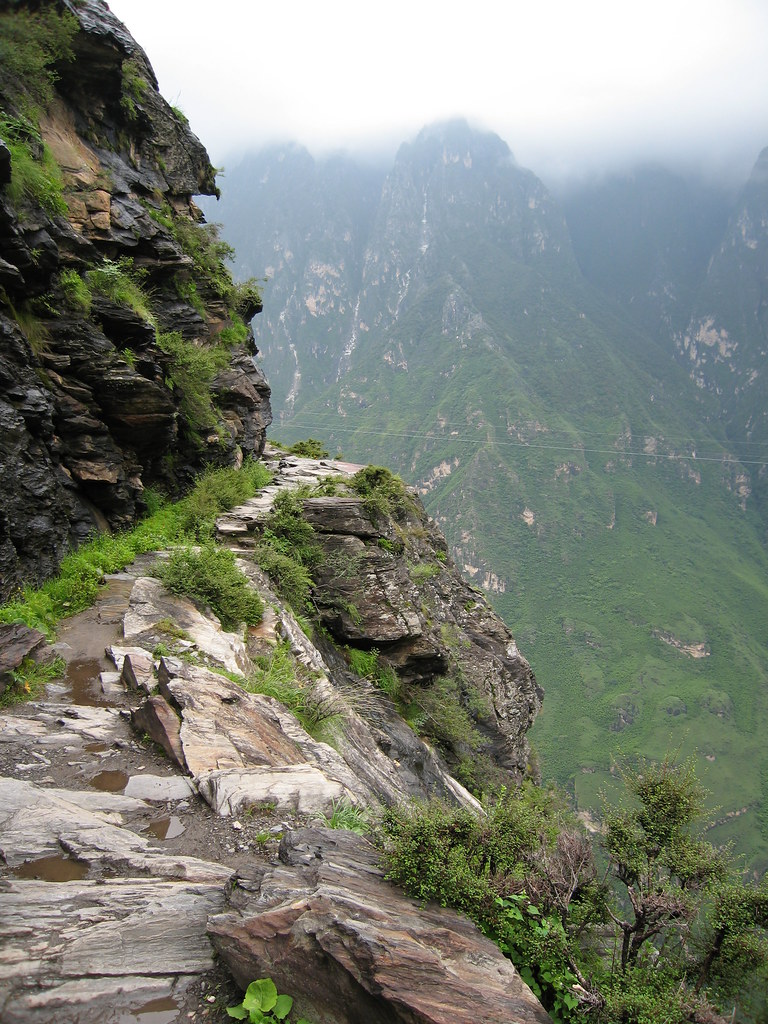
Our next stop was a 2 day hike through Tiger Leaping Gorge, allegedly the deepest gorge in the world. Again, it's a heavily visited spot but thankfully the bus tourists are all confined to the bottom of the gorge close to the river (and near the bus parking lot). The hiking trail wanders high up the gorge along a tranquil scenic route far away from the hustle and bustle below. Hiking the gorge is relatively straightforward, you leave any big luggage under lock and key at the start of the hike and take off with a small bag, some water and a map. There are guesthouses dotted along the trail and red arrows mark the way. In total the trek takes about 8 hours. Most people complete it in an easy two day outing leaving lots of time to enjoy the scenery.


We set off early aiming to reach the halfway mark that day. There is only one place that you can go the wrong way, there are red arrows literally marking every conceivable wrong move you could make except this first one. A bunch of locals saw us go off in the complete wrong direction and said nothing - they've since been hexed. Three hours later we were still scrambling up the side of a mountain in the rain trying to find non existent red arrows. After asking a local to direct us to the right path he sent us up higher, way up into the already elevated altitude. Eventually after 7 hours we found a group of houses and asked for some help with getting back to civilisation. Weather conditions had made wearing our motorbike ponchos compulsory so we must have looked a right sight when the people answered the door to us. A local man walked us a couple of kilometers down the other side of the mountain back onto the trail. I'm sure he was wondering where we left the motorbike!

After a dismal first day and a hard seven hours of climbing we ended up a mere two hours into the hike. We turned up like drowned rats at Naxi Family Guesthouse and were greeted with cups of tea, piping hot showers and superb food - some of the best we've had in China. That's the way we remember it ... maybe it was the relief of finding the path with the red arrows. Anyhow after a good night's sleep we woke up without too much muscle fatigue and managed to complete the hike. After the previous days exertions the remainder of the hike seemed like a dawdle - all we'd to do after all was to follow the red arrows to the end and enjoy the spectacular views and incredible mountains all around us.

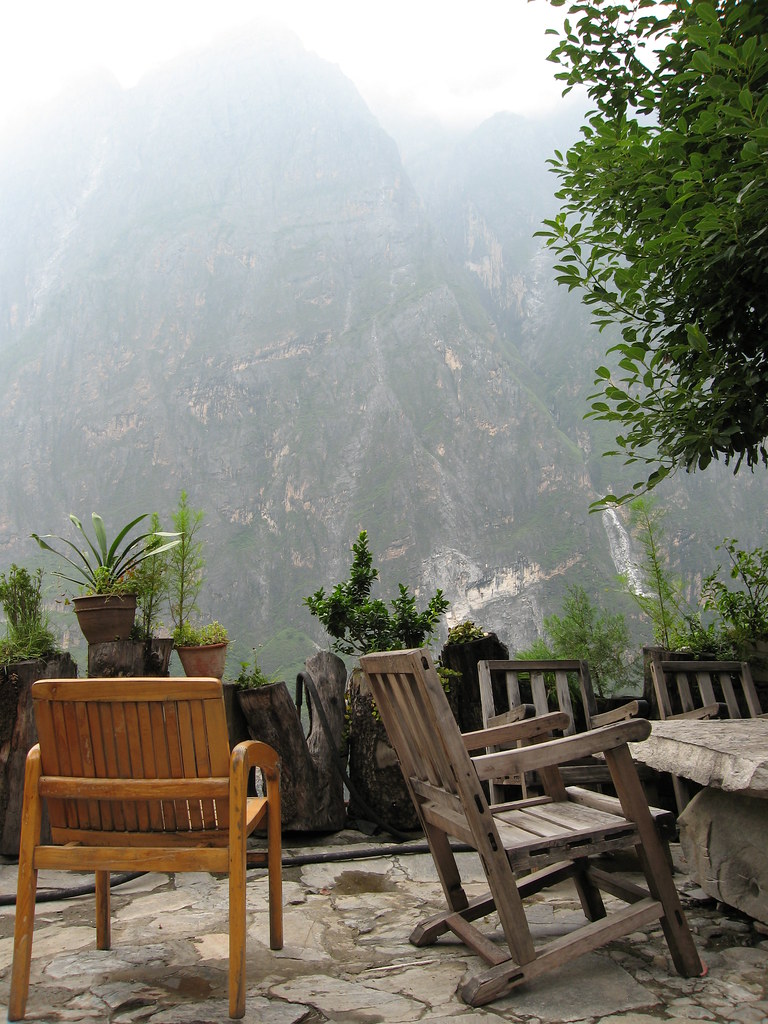
:: The End of the Rd. - View from Seans ::

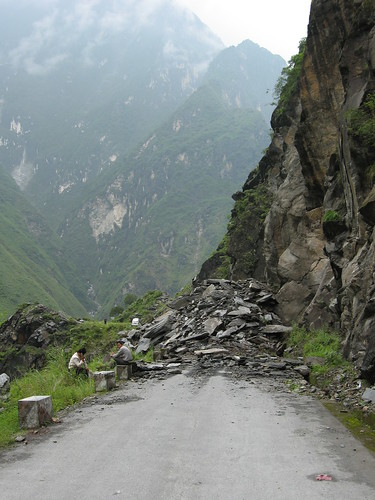
We stayed the second night in Walnut Garden where lots of backpackers round off the trek before heading back via taxi to pick up their big bags and head on to the next destination. Our excitement didn't end there however, heavy rainfall had caused two landslides on the road back forcing us to clamber over the debris watching out for falling rocks. Luckily/unluckily a minivan was stuck in the middle of the two landslides so he was able to ferry us the few kilometers between landslides.


Our next stop was the charming old city of Zhongdian (3400m) where we chilled out for few days soaking up the hot sun and getting used to the thin air. Of all the old cities we've been to in China this is by far our favourite, its small scale, restored buildings, cobbled streets and the lack of tourists around made it a perfect place to relax. The aroma of bbq-ed skewers wafted from the old town square all day as stall upon stall cooked up beef, pork, potato and veggie skewers. In the evening the stalls were cleared away to make room for the locals to dance in the square. The dancing was attended by everyone from the old ladies of the village, to the local policeman to toddlers ... and surprisingly it wasn't all put on for tourists... there were only a few of us there watching on has they danced for hours nightly. It was neighbourhood aerobics in it's purest form.


:: Dancing in Zhongdian ::

We found ourselves traveling along the same route as Aussies Blake & Ros and Stu & Jane. After a couple of packs of cards were introduced we settled into a couple of competitive nights of cards interrupted only by last minute dashes down to make the skewer ladies before they packed up for the night. Jane and Stu suggested a day trip of picking a nearby mountain and climbing it with a picnic. The contents of the picnic quickly expanded to included a kilo of the finest yak cheese and a couple of bottles of Yunnan red - that was all the incentive the rest of us needed. The following morning laden down with a massive picnic we marched up the selected mountain and polished the lot off. After a fabulous picnic we made a somewhat giddy decent back into down ... no ordinary hike indeed... positively flashpackery.
Our next stop in the weird town of Daocheng, as it's national park Yading is currently closed there is no reason to spend any time in this place; you stop for the night and then escape as quickly as possible the following day.


We arrived in Daocheng after a horrendous day of traveling. Not only did we get a puncture that day but as night fell and we were climbing hairpin bend roads over an extremely high pass (no trees or vegetation to be seen out the window) the engine started making funny noises as the universal joint totally gave up on us. Thankfully we made it to the top and pretty much freewheeled down the other side of the mountain into a town where we were met by a mechanic. After a bit of old school soldering and hammering (using the car headlights as a flashlight) the universal joint was miraculously fixed and we rolled on into the kip that is Daocheng.


:: Litang Monastery ::

Escape from Daocheng to our destination of Litang the following morning turned out to be another nightmare. A minibus driver agreed to take us and a price was negotiated and agreed - then he refused to leave. These antics went on for couple of hours spreading to all the drivers in town until they were demanding a ridiculous amount of money. We got so infuriated that we all ended up ignoring them, going for a beer and telling them we were quite happy to wait for the bus the following day rather than bow to their greed. At 2pm tickets went on sale for the bus, by 2:01pm in a massive crush the tickets were all sold out leaving us with limited options. Luckily we found a driver returning to Litang and all hopped in willing him to drive us out of town before he changed his mind like the rest of the drivers. Nobody relaxed until we were a couple of miles out the road and well clear of Daocheng.We stopped for a couple of nights in the Tibetan town of Litang - highlights included giving the yak meat dishes a go and visiting the monastery.


:: View Over Litang ::

Our next stop was the wild west cowboy Tibetan town of Tagong located in the middle of the Sichuan rolling grasslands. Tagong is a one street colourful trading town - the local woman wear heavy silver jewelery and weave a red braid and yak bones into their hair. Most of the local men have long flowing hair and stride around in cowboy hats. We stayed in Gayla's Guesthouse a Tibetan home converted into funky accommodations - the dorm rooms were there most ornate one's we've seen to date.

After a couple of one night stops in Danba and Kangding we hopped on a super deluxe bus (unintentionally) and floated into Chengdu city hours ahead of schedule. Luck continued to be on our side when we found out that there were only two tickets left for the train to Lhasa on the 2nd of September. (The Tickets are sourced from the black market, such is the demand...)

The next thing on the agenda is to go and do a big shop for foodstuffs for the train, the Chinese are the masters of individually wrapped snack foods, entire supermarket floors are filled with every type of snack imaginable. There's no excuse for boarding without preserved eggs, vacuum packed skewers, jellies and a carefully chosen range of noodle dishes.

So, that's the saga so far, it's time to say farewell to China and take the a train up to the rooftop of the world, Tibet & Nepal, here we come.


Read more...

China's Wild (Sth) West...


:: Lijiang ::

Since departing Myanmar we've spent the month of August high, high up in the Chinese mountains with yaks. Internet has been sparse so once again we're doing a big catchup on all our highlights of the past few weeks. This entry also concludes our time in China; on the 2nd of September, we hop into our bunks and travel on the highest train journey in the world (reaching 5072m) from Chengdu to Lhasa, Tibet.

From Myanmar our route back into China was a flight to the city of Kunming. We'd spent a few days here before so it was a familiar stomping ground. After a sneaky Big Mac we were ready to tackle the tasty noodle soups and skewers served up in the Muslim quarter. After a couple of days of getting back into the swing of using our Mandarin numbers and elbowing our way onto public transport we were ready to head north and tackle the rest of the Yunnan province - and further afield.


:: Dali ::

Our first stop was Dali an ancient city that has undergone extensive restoration. Flanked by a mountain, and surrounded by high city walls and a moat this city is a mecca for Chinese tourists. We spent quite a bit of time watching all the ridiculous photo opportunities that people were taking outside the city walls amidst downpours of rain. As a major tourist destination there were no shortage of restaurants to cater for demand. One thing that has shocked us is that since we were here eight months ago the price of meat has risen by a whopping 45%. Luckily we saw this fact on TV otherwise we'd still believe that people were trying to rip us off. Unfortunately we left Dali before realising that one of the most famous "chinglish" signs lived there, it's a famous sign over a squat toilet that simply reads "No shitting in the toilet". Moving north in the full brunt of the region's wet season we reached the picturesque city of Lijiang. Despairingly we reached the labyrinth of the old town as darkness was falling and when there wasn't much room at any of the inns. Arriving under such conditions is always the worst part about backpacking, particularly when the bags are getting heavier and wetter. Adding to the stress were armies of tiny Chinese tourists barging around with umbrellas held at a dangerously eye gouging height - well for me anyhow. Whenever they tried to pass Marcus they bizarrely would attempt to raise their umbrella over and above his! The following morning bathed in sunshine, Lijiang looked a lot more appealing - although the peril of the sun umbrella was still threatening. We managed to find a perfect little traditional Naxi courtyard guesthouse complete with a friendly pregnant owner who when asked when the baby was due replied "it's coming in two days".

The old narrow streets of Lijiang are lined with small waterways and little bridges making it a quirky little place with lots of character. The local ethnic minority in the region is the Naxi people and their Dongba religion and culture, of Tibetan origin, is an important part of the music, paintings and lives of the people. Lijiang is also an extremely popular destination for rich domestic tourists; after dark the bars and restaurants are full of this breed favouring expensive imported Heineken in place of their cheaper local brew. The rowdiness and noise level gradually elevates as rival bars compete in "sing offs" across the canals. Literally one bunch of girls trying to out-sing the other, what's more is that it appears to be the same song that they sing all night, every night.

After getting caught out in the rain badly once, we decided to invest in some very stylish ponchos... and they're not of the normal variety... we got ones that would definitely keep us and our backpacks dry. Designed to cover one's entire body on a motorbike (Marcus's has a see-through bit at the front so the headlights can shine through) this rain attire means business, we left Lijiang as ready for rain as Noah was for the great flood.


Our next stop was a 2 day hike through Tiger Leaping Gorge, allegedly the deepest gorge in the world. Again, it's a heavily visited spot but thankfully the bus tourists are all confined to the bottom of the gorge close to the river (and near the bus parking lot). The hiking trail wanders high up the gorge along a tranquil scenic route far away from the hustle and bustle below. Hiking the gorge is relatively straightforward, you leave any big luggage under lock and key at the start of the hike and take off with a small bag, some water and a map. There are guesthouses dotted along the trail and red arrows mark the way. In total the trek takes about 8 hours. Most people complete it in an easy two day outing leaving lots of time to enjoy the scenery.


We set off early aiming to reach the halfway mark that day. There is only one place that you can go the wrong way, there are red arrows literally marking every conceivable wrong move you could make except this first one. A bunch of locals saw us go off in the complete wrong direction and said nothing - they've since been hexed. Three hours later we were still scrambling up the side of a mountain in the rain trying to find non existent red arrows. After asking a local to direct us to the right path he sent us up higher, way up into the already elevated altitude. Eventually after 7 hours we found a group of houses and asked for some help with getting back to civilisation. Weather conditions had made wearing our motorbike ponchos compulsory so we must have looked a right sight when the people answered the door to us. A local man walked us a couple of kilometers down the other side of the mountain back onto the trail. I'm sure he was wondering where we left the motorbike!

After a dismal first day and a hard seven hours of climbing we ended up a mere two hours into the hike. We turned up like drowned rats at Naxi Family Guesthouse and were greeted with cups of tea, piping hot showers and superb food - some of the best we've had in China. That's the way we remember it ... maybe it was the relief of finding the path with the red arrows. Anyhow after a good night's sleep we woke up without too much muscle fatigue and managed to complete the hike. After the previous days exertions the remainder of the hike seemed like a dawdle - all we'd to do after all was to follow the red arrows to the end and enjoy the spectacular views and incredible mountains all around us.

:: The End of the Rd. - View from Seans ::

We stayed the second night in Walnut Garden where lots of backpackers round off the trek before heading back via taxi to pick up their big bags and head on to the next destination. Our excitement didn't end there however, heavy rainfall had caused two landslides on the road back forcing us to clamber over the debris watching out for falling rocks. Luckily/unluckily a minivan was stuck in the middle of the two landslides so he was able to ferry us the few kilometers between landslides.


Our next stop was the charming old city of Zhongdian (3400m) where we chilled out for few days soaking up the hot sun and getting used to the thin air. Of all the old cities we've been to in China this is by far our favourite, its small scale, restored buildings, cobbled streets and the lack of tourists around made it a perfect place to relax. The aroma of bbq-ed skewers wafted from the old town square all day as stall upon stall cooked up beef, pork, potato and veggie skewers. In the evening the stalls were cleared away to make room for the locals to dance in the square. The dancing was attended by everyone from the old ladies of the village, to the local policeman to toddlers ... and surprisingly it wasn't all put on for tourists... there were only a few of us there watching on has they danced for hours nightly. It was neighbourhood aerobics in it's purest form.


:: Dancing in Zhongdian ::

We found ourselves traveling along the same route as Aussies Blake & Ros and Stu & Jane. After a couple of packs of cards were introduced we settled into a couple of competitive nights of cards interrupted only by last minute dashes down to make the skewer ladies before they packed up for the night. Jane and Stu suggested a day trip of picking a nearby mountain and climbing it with a picnic. The contents of the picnic quickly expanded to included a kilo of the finest yak cheese and a couple of bottles of Yunnan red - that was all the incentive the rest of us needed. The following morning laden down with a massive picnic we marched up the selected mountain and polished the lot off. After a fabulous picnic we made a somewhat giddy decent back into down ... no ordinary hike indeed... positively flashpackery.
Our next stop in the weird town of Daocheng, as it's national park Yading is currently closed there is no reason to spend any time in this place; you stop for the night and then escape as quickly as possible the following day.


We arrived in Daocheng after a horrendous day of traveling. Not only did we get a puncture that day but as night fell and we were climbing hairpin bend roads over an extremely high pass (no trees or vegetation to be seen out the window) the engine started making funny noises as the universal joint totally gave up on us. Thankfully we made it to the top and pretty much freewheeled down the other side of the mountain into a town where we were met by a mechanic. After a bit of old school soldering and hammering (using the car headlights as a flashlight) the universal joint was miraculously fixed and we rolled on into the kip that is Daocheng.


:: Litang Monastery ::

Escape from Daocheng to our destination of Litang the following morning turned out to be another nightmare. A minibus driver agreed to take us and a price was negotiated and agreed - then he refused to leave. These antics went on for couple of hours spreading to all the drivers in town until they were demanding a ridiculous amount of money. We got so infuriated that we all ended up ignoring them, going for a beer and telling them we were quite happy to wait for the bus the following day rather than bow to their greed. At 2pm tickets went on sale for the bus, by 2:01pm in a massive crush the tickets were all sold out leaving us with limited options. Luckily we found a driver returning to Litang and all hopped in willing him to drive us out of town before he changed his mind like the rest of the drivers. Nobody relaxed until we were a couple of miles out the road and well clear of Daocheng.We stopped for a couple of nights in the Tibetan town of Litang - highlights included giving the yak meat dishes a go and visiting the monastery.


:: View Over Litang ::

Our next stop was the wild west cowboy Tibetan town of Tagong located in the middle of the Sichuan rolling grasslands. Tagong is a one street colourful trading town - the local woman wear heavy silver jewelery and weave a red braid and yak bones into their hair. Most of the local men have long flowing hair and stride around in cowboy hats. We stayed in Gayla's Guesthouse a Tibetan home converted into funky accommodations - the dorm rooms were there most ornate one's we've seen to date.

After a couple of one night stops in Danba and Kangding we hopped on a super deluxe bus (unintentionally) and floated into Chengdu city hours ahead of schedule. Luck continued to be on our side when we found out that there were only two tickets left for the train to Lhasa on the 2nd of September. (The Tickets are sourced from the black market, such is the demand...)

The next thing on the agenda is to go and do a big shop for foodstuffs for the train, the Chinese are the masters of individually wrapped snack foods, entire supermarket floors are filled with every type of snack imaginable. There's no excuse for boarding without preserved eggs, vacuum packed skewers, jellies and a carefully chosen range of noodle dishes.

So, that's the saga so far, it's time to say farewell to China and take the a train up to the rooftop of the world, Tibet & Nepal, here we come.


Read more...

Wednesday, February 07, 2007

Kunming

Our route to warmer Kunming in Yunnan province took us on a snowy journey through Liping, Kaili, Duyang (we went here by accident) and on to the provincial capital Guiyang where we caught the overnight train to Kunming. At all the stops along the way people stared at us more than usual - it's definitely not tourist territory around here. If you smile and say "Ni Hao" to small children here there more likely to burst into tears than do anything else.

We travelled along brand new toll roads for most of the journey - new road engineering has produced roads perched high up on huge concrete bridges hundreds of metres in the air. These new roads rise high above hilly terrain and where they can't they use tunnels to go through. From the bus we spotted a couple of "new cities".... cities where hundreds of thousands of apartments have been constructed. For the moment these cities lie completely empty. No doubt part of a huge government relocation project in the near future.

We spent a week in Kunming doing two things... looking around the plethora of sports and outdoor shops around the city and internet catchup. After spending hours and hours in an internet cafe uploading pictures and getting the blog up to date we finally have a clean slate and conscience.

Currently we are in Jinghong in the south of Yunnan province... This weekend we'll be heading towards more sun - in Laos.

Read more...

Kunming

Our route to warmer Kunming in Yunnan province took us on a snowy journey through Liping, Kaili, Duyang (we went here by accident) and on to the provincial capital Guiyang where we caught the overnight train to Kunming. At all the stops along the way people stared at us more than usual - it's definitely not tourist territory around here. If you smile and say "Ni Hao" to small children here there more likely to burst into tears than do anything else.

We travelled along brand new toll roads for most of the journey - new road engineering has produced roads perched high up on huge concrete bridges hundreds of metres in the air. These new roads rise high above hilly terrain and where they can't they use tunnels to go through. From the bus we spotted a couple of "new cities".... cities where hundreds of thousands of apartments have been constructed. For the moment these cities lie completely empty. No doubt part of a huge government relocation project in the near future.

We spent a week in Kunming doing two things... looking around the plethora of sports and outdoor shops around the city and internet catchup. After spending hours and hours in an internet cafe uploading pictures and getting the blog up to date we finally have a clean slate and conscience.

Currently we are in Jinghong in the south of Yunnan province... This weekend we'll be heading towards more sun - in Laos.

Read more...

Zhaoxing : Wooden Bridges, Metre High Arsonists and a Beard Butcher


The journey from Sanjiang to Zhaoxing is a breathtaking ride up high into the mountains. There are amazing views of surreal green terrace fields and valleys below - through the fog we caught a glimpse of some of these. The experience is aided by the new smooth road that snakes along the route.

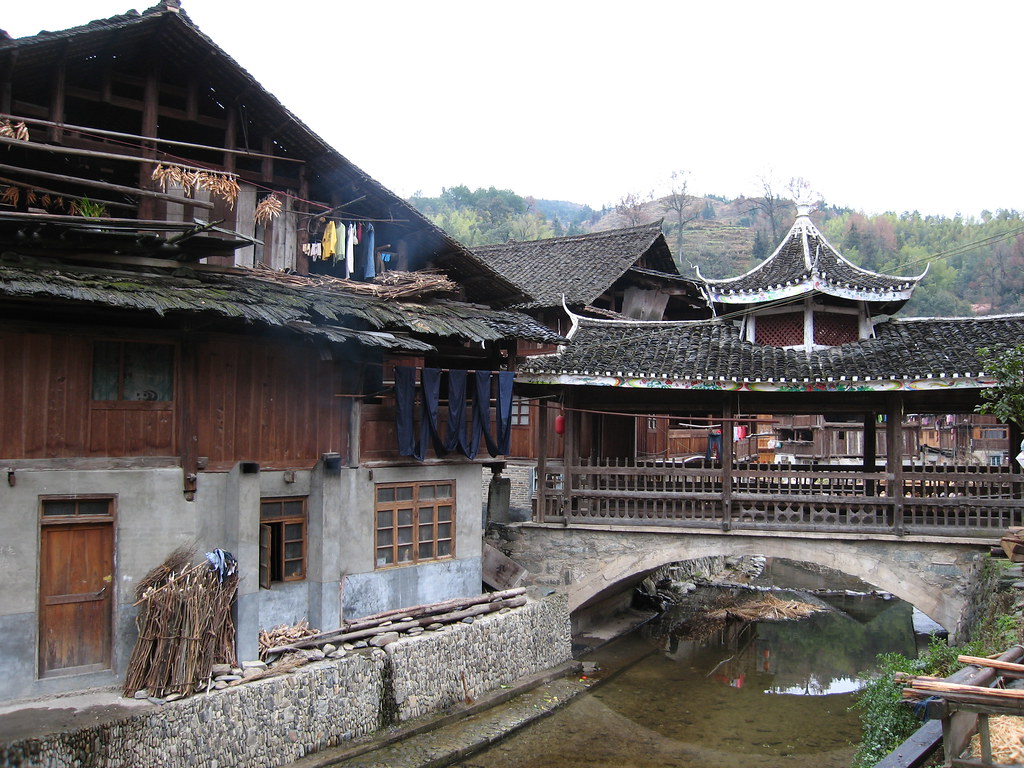
Zhaoxing, another wooden Dong village which has a picturesque location in a green valley, it looks like a Swiss alpine village tucked away in the mountains. With it's five drum-towers and many covered bridges over little rivers it has a unique character of it's own. Local craft making is a big industry in this town. Women make an indigo cloth which is pounded for hours with a wooden mallet; the dyed cloth can be seen hanging out to dry throughout the town. The cloth is embroidered and used for batiks and traditional clothing.

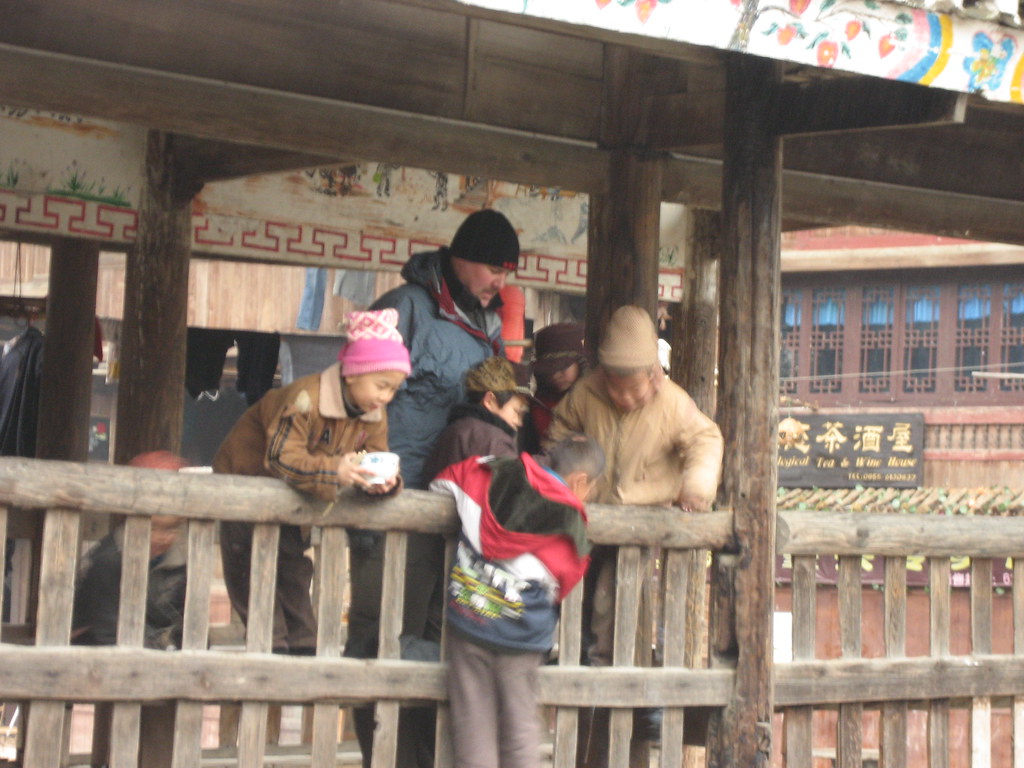
The village streets are overrun by an army of small boys up to no good. While their female counterparts are off helping around the house these 4 year olds are busy throwing bangers (grenade style - they've seen the movies) in doorways, under old peoples feet and into rubbish bins then running away around the corner. It's like Baghdad - the explosion noises are deafening. Those who have no bangers can be found in little groups on the ancient wooden bridges with a lighter and any flammable item the arsonists can find - toilet paper seemed to be easy to source! The fires are lit with great excitement, once they've gone out, a search party heads out to find more fuel. It's not the wisest of "games" to be playing in a village constructed solely of wood.


Marcus couldn't resist getting a closer look at the "exploding banger underwater" move .... after revealing he'd a supply of matches in his pocket he quickly attracted a crowd.

Marcus picks up the tale...

One of the obvious activities while travelling is getting a haircut, well for most anyway. I have had the nervous pleasure of striding into barbers in Mongolia and China, gesticulating vaguely then walking out a dollar or two lighter, clean cut. Under our hotel in Zhaoxing was a small hairdresser so I decided to head in to get the usual blade 3 all over ( beard included).
As is custom I set a price before he got going - it would cost 10 RMB which is 1 euro.
Round 1 - Gesticulation from barber (translated as " do you want a hair wash?"
(The old tactic of changing the service to change the price me thinks....so " no thanks")
Round 2 - clippers vs hair, no problem at all.
Round 3 - clippers vs beard, quick run through, no problem.
Round 4 - Barber produces a cut throat and starts tidying up the outline of the beard, during this he motions to the washing station - OK, I think, he wants to lather me up and do a proper job.
Round 5 - Mr barber guy washes my hair and starts getting out all these steamy towels.
Round 6 - The razoring continues...and continues...I'm thinking he has made a mistake and is balancing things up...but it continues...and continues...until he is done.
Round 7 - Merv or Chopper ? ......(Oh and all that razoring was still 10RMB )


We had Zhaoxing village completely to ourselves.... all the other tourists had sensibly stayed in the southern provinces out of the winter cold. The tourist information centre was closed for the winter and even the locals were wearing multiple layers and huddled around fires to keep warm. Marcus remarked that something is wrong when it's too cold to enjoy a cold beer.

Taking a hike a couple of miles out of the village (to keep warm) we decided that we'd be miserable further north where it's even colder being cold all the time is too much effort ..... so we're calling a spade and spade and running south to the sunshine.

Read more...

Zhaoxing : Wooden Bridges, Metre High Arsonists and a Beard Butcher


The journey from Sanjiang to Zhaoxing is a breathtaking ride up high into the mountains. There are amazing views of surreal green terrace fields and valleys below - through the fog we caught a glimpse of some of these. The experience is aided by the new smooth road that snakes along the route.

Zhaoxing, another wooden Dong village which has a picturesque location in a green valley, it looks like a Swiss alpine village tucked away in the mountains. With it's five drum-towers and many covered bridges over little rivers it has a unique character of it's own. Local craft making is a big industry in this town. Women make an indigo cloth which is pounded for hours with a wooden mallet; the dyed cloth can be seen hanging out to dry throughout the town. The cloth is embroidered and used for batiks and traditional clothing.

The village streets are overrun by an army of small boys up to no good. While their female counterparts are off helping around the house these 4 year olds are busy throwing bangers (grenade style - they've seen the movies) in doorways, under old peoples feet and into rubbish bins then running away around the corner. It's like Baghdad - the explosion noises are deafening. Those who have no bangers can be found in little groups on the ancient wooden bridges with a lighter and any flammable item the arsonists can find - toilet paper seemed to be easy to source! The fires are lit with great excitement, once they've gone out, a search party heads out to find more fuel. It's not the wisest of "games" to be playing in a village constructed solely of wood.


Marcus couldn't resist getting a closer look at the "exploding banger underwater" move .... after revealing he'd a supply of matches in his pocket he quickly attracted a crowd.

Marcus picks up the tale...

One of the obvious activities while travelling is getting a haircut, well for most anyway. I have had the nervous pleasure of striding into barbers in Mongolia and China, gesticulating vaguely then walking out a dollar or two lighter, clean cut. Under our hotel in Zhaoxing was a small hairdresser so I decided to head in to get the usual blade 3 all over ( beard included).
As is custom I set a price before he got going - it would cost 10 RMB which is 1 euro.
Round 1 - Gesticulation from barber (translated as " do you want a hair wash?"
(The old tactic of changing the service to change the price me thinks....so " no thanks")
Round 2 - clippers vs hair, no problem at all.
Round 3 - clippers vs beard, quick run through, no problem.
Round 4 - Barber produces a cut throat and starts tidying up the outline of the beard, during this he motions to the washing station - OK, I think, he wants to lather me up and do a proper job.
Round 5 - Mr barber guy washes my hair and starts getting out all these steamy towels.
Round 6 - The razoring continues...and continues...I'm thinking he has made a mistake and is balancing things up...but it continues...and continues...until he is done.
Round 7 - Merv or Chopper ? ......(Oh and all that razoring was still 10RMB )


We had Zhaoxing village completely to ourselves.... all the other tourists had sensibly stayed in the southern provinces out of the winter cold. The tourist information centre was closed for the winter and even the locals were wearing multiple layers and huddled around fires to keep warm. Marcus remarked that something is wrong when it's too cold to enjoy a cold beer.

Taking a hike a couple of miles out of the village (to keep warm) we decided that we'd be miserable further north where it's even colder being cold all the time is too much effort ..... so we're calling a spade and spade and running south to the sunshine.

Read more...

Friday, February 02, 2007

Chengyang Village


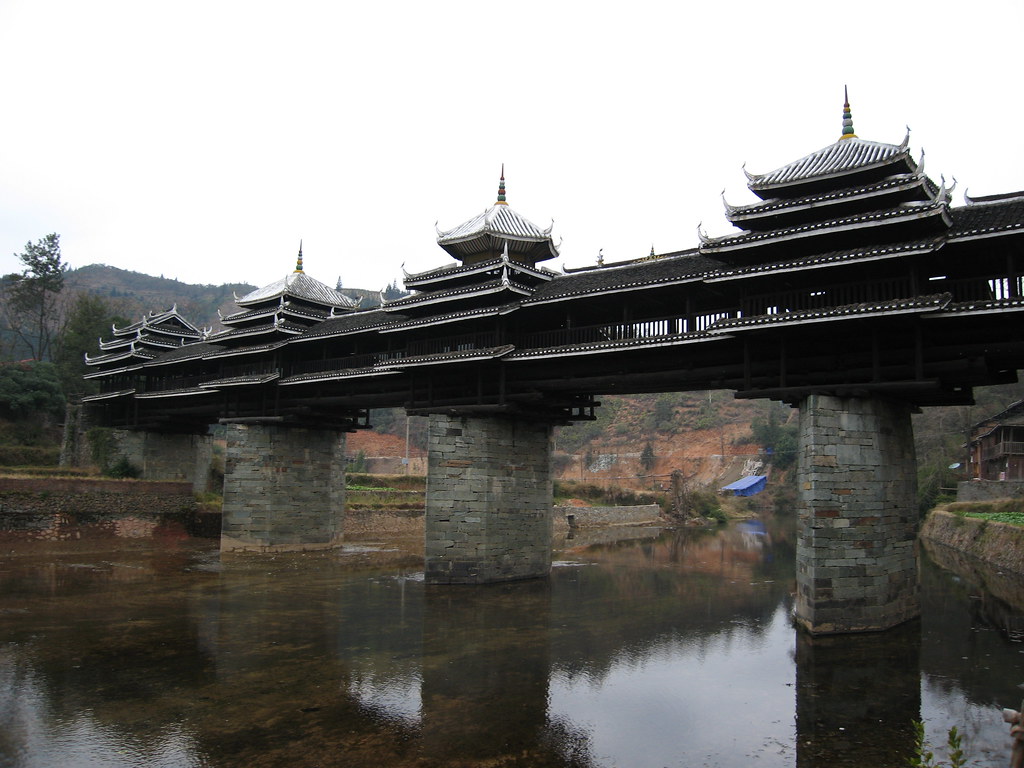
:: Chengyang Wind & Rain Bridge ::

A guesthouse owner commented that no tourists were coming to Chengyang these days because the main road between Longsheng and Sanjiang was "broken". It is a perfect way to describe the "route"; for hours we were thrown around in a little local bus, there were road works (huge boulders and deep holes) the entire way and the conditions got progressively worse as we approached Sanjiang. As usual all the men on the bus chain smoked so to get a breath of fresh air meant opening the window and letting the biting cold in. Our little bus had a double bed and mattress tied onto the roof - this was a light load in comparison to some of the other buses which had beds, sofas, entertainment units and huge boxes stacked high. When stuck in these situations all you can do is let the mind wander and hope that the good road is just around the corner. We stopped a few times en route to squeeze in more passengers, let a man on with a bag of piglets and to let the old woman and her roof top bed off.

Making it to the town of Sanjiang just as darkness fell we located the local minivan drivers and went about finding one to take us to the small Dong village of Chengyang some 20km away. As usual 10 minutes were wasted trying to find a driver who would take us for the correct price there were at least six vans sharking around us with out of this world quotes. We eventually found an honest guy who wanted the business and climbed into his van, half an hour later, after we'd a bum on every seat, we headed off.

Chengyang is made up of eight minority Dong villages, the Dong villages were traditionally built alongside rivers so people lived opposite each other. To connect the villages "Wind and Rain" covered bridges were built. The covered wooden bridges are built without using any nails, the interior corridor is ornately carved, they contain tower like kiosks and a long bench lining each side - a resting spot for the locals (selling spot to the tourists these days). Chengyang or Yongli Bridge is regarded as the best preserved "Wind and Rain" bridge in the region.

In pitch darkness the van let us off at Chengyang Bridge that apparently lead to the Ma'an village. We were barely out of the van when an official looking guy in a uniform appeared from nowhere (just like the troll in Billy Goat's Gruff) and told us we couldn't cross the bridge without a ticket. Taking out our miner headlamps we told him we'd be back tomorrow and looked around for the concrete service bridge. In the darkness we settled for the first guesthouse we came across that had a light on. Wandering around looking for food later we happened upon a small new guesthouse & restaurant run by a local tourism graduate Yang and his girlfriend. He generously invited us to his nephew's "one year old" birthday party - a Dong tradition where the whole village is invited to celebrate. He lead us to his sister's house and into a room full of people of all ages sitting on little wooden stools around a big cooking fire in the centre of the room. The women were busy stirring huge mass catering pots of what looked like stew over the fire.

We had a fantastic evening where everyone welcomed us to the village. When it came to eating multiple servings of sour fish, pickled pork, pickled vegetable and bowls of rice congee (rice porridge) were placed on the table (The Dong like their sour food). The grandfather of the family sat beside us serving warm rice wine and leading the table in the local toast "pong bei". We were initially concerned that our presence might leave things a little tight on the food front... far from it ... there was enormous quantities that we never even touched. We were very lucky to have tasted all the Dong dishes in this setting. Dong food is very distinctive, lots of the dishes are pickled and prepared like a stew, their local speciality is pickled duck which is best eaten a least 5 years later. (The duck is dried over the fire then packed in pots for at least 5 years - the longer the better)

The villagers told us that the best time to visit the Dong minorities is during Chinese New Year. This is the one day the Dong people are permitted to marry - there will be about 200 marriages this year. This brings the whole village out in celebration as dowry exchanges and traditional parades are part of the Dong wedding tradition.


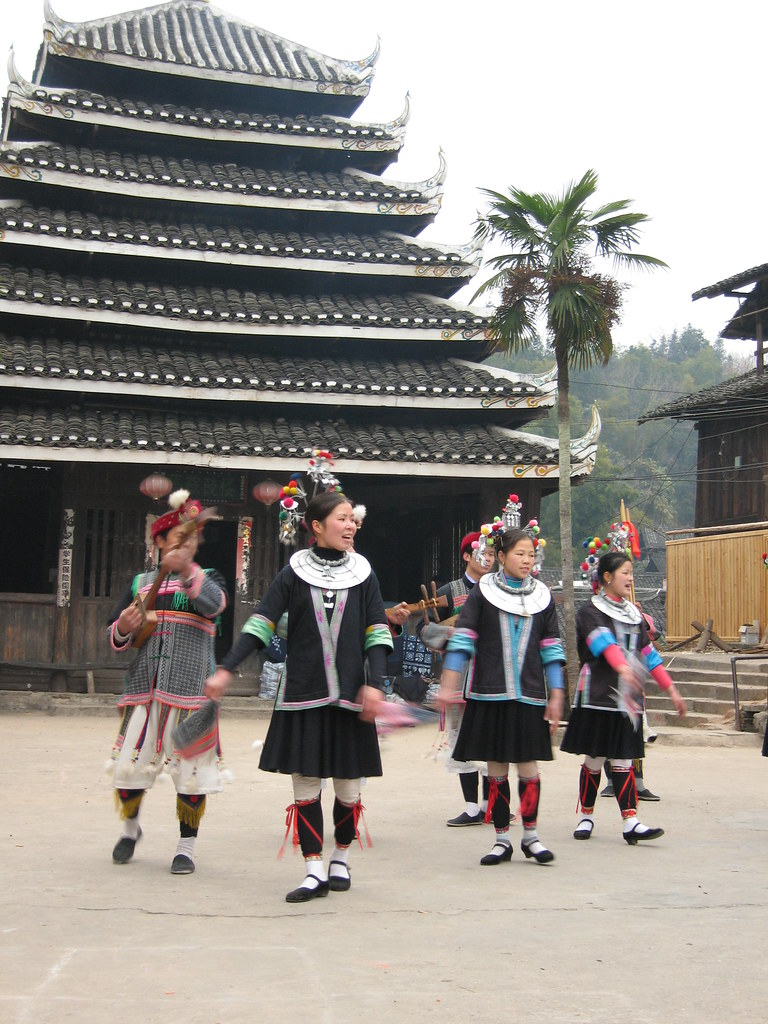
:: Ma'an Village Drum Tower & Performers ::

We moved to "Yang's Guesthouse" the following morning and explored the surrounding villages. The houses are wooden and built in a unique Dong style with the proud focal point of each village being a drum-tower. For a small donation you can have your name immortalised on slate in one of the towers. There is a thriving local industry in the area and on our walk around we saw the local butcher slaughtering and gutting a pig, rice being thrashed, quilted covers being packed and the busy local market's comings and goings.


:: Some for pickling, some for dinner & maybe even some for the pooch ::

The Dong minority didn't have a writing system of their own until 1958, their history and stories were all recorded and passed down through songs. The most popular form of song is the 'grand song' which contains various themes ranging from love stories to historical events to moral lessons. These are all performed by a chorus, and the formal performing place is the village drum-tower.That afternoon at the Ma'an village drum-tower we got to see some locals (some of which we had met at the party) perform these songs and dances - we even got to join in in the finale!


Cold weather and subzero nights are keeping us on the move.

Thanks to the generosity of Yang and his family, we fantastically unique experience in this village. When the road is "fixed" it is a worthwhile spot to spend a couple of days exploring.

Read more...

  © Blogger templates The Professional Template by Ourblogtemplates.com 2008

Back to TOP