Monday, January 19, 2009

new one

some stuff in here


the rest here as it will the the bilk of it all.....

Read more...

Monday, January 12, 2009

Peru


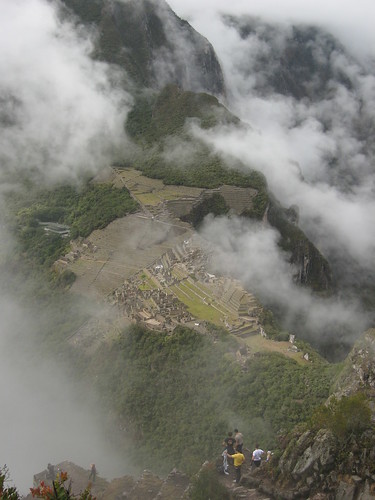
:: Looking down as Machu Picchu is revealed ::

So, after a brief stop at the Peruvian border and a change of coach in Puno we found ourselves on a bus up to Cusco. It's been several years since I was last in Cusco but it's changed in many ways. The most obvious change is how flash and well heeled it's all become. Gone from the main square are all the backpacker restaurants playing movies all day long. They've been replaced by very swish restaurants, coffee shops and pizza parlours. Thankfully, famous Gringo Alley with cheap and cheerful restaurant still exists and the number of hotels has risen dramatically so the squeeze for accommodation is gone. Our top finds in Cusco were our accommodation with a rooftop view over the square and our discovery of a jam packed local pizza joint that served very tasty wood fired pizzas.
Cusco is of course the famous jumping off point to access Machu Picchu, our time there coincided with a train strike, so no trains were going to Aguas Calientes, the town at the base of Machu Picchu. Lots of agencies were offering bus tours so we started enquiring into them. After a lot of confused information we finally realised that the only way of getting to Machu Pichhu is by train (there is no road) and the train tickets are outrageously expensive despite having three different classes of service. There is a complicated back door way of getting there that takes 2-3 days and involves catching buses in the middle of the night and walking along the train tracks for hours etc. I went to the official tourist office in Cusco and the girl actually explained this option with a straight face. Ordinarily with time on our side we would have opted for this route. Annoyingly Peru rail have the whole thing sewn up and are very obviously cashing in on tourists. There are high class carriages, super high class carriages and then ordinary carriages full of locals. Some tourists will always want to take the comfortable more expensive option but it's unfair to not provide a reasonably priced option to budget travellers.


:: Well worth the effort ::

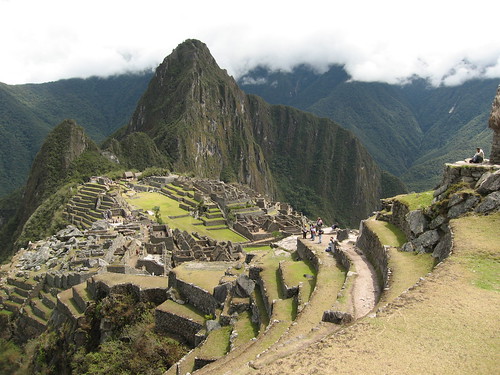
Anyhow, we swallowed the cost, made our way to Ollanytambo connected with our swish train and arrived into Aguas Calientes in time to buy entrance tickets for Machu Picchu for the following morning. At the early hour of 4am we began the long walk up hundreds of steps up into the entrance. Competitive elbowing and jostling was in full swing in the queue at the entrance as people waited impatiently for the gates to be thrown open so we could all foot race to the other side of the site to get into a second queue to be one of the 200 people allowed to climb up Wanupicchu daily (the big mountain you see in photographs behind the ruins). It was a shame really, very few people looked around them and admired a tranquil, empty, pre-tourist filled Machu Picchu.

A steep, sheer, one hour rope-aided uphill clamber later, and we were atop Wanupicchu and into the clouds. We all found a perch at very (small) summit and could see nothing but mist all around. Needless to say this didn't seem to be good. Who knew if or when the clouds would lift - and we were facing a timeline - we had to see the rest of the site and make it back down the path to our afternoon train out. Magically, fantastically and dramatically, after 25 minutes or so the clouds began to melt away underneath us as the morning air warmed and the awesome site of Machu Picchu was slowly revealed hundreds of metres below. In hindsight you could not hope for a better way to first lay eyes on the site. It was breathtaking, one of our real emotional visual highlights. The birds eye vantage point makes the experience; you can see the full scale and precarious positioning of the site on its mountaintop. You find yourself continuously asking, how ? and why ?. Honestly, its hard enough for us to get there and see it now, you cannot imagine how the Incas would have gone about constructing such a marvel. Scrambling back down we joined the throngs of visitors visiting the site and getting eaten alive by invisible insects.

Our visit to Machu Picchu came to and end and we raced back down to Aguas Calientes to catch the 2pm train back towards Cusco. We also had the pleasure of travelling tourist class, one step up from backpacker class. One enjoys frills such as a glass roof vista and free sandwich.... the extras didn't stop there. After handing out the food our carriage attendants proceeded to change into costumes and perform an interpretive dance down the aisle of the train. It all went from bad to worse when it was closely followed by a full on fashion show of Alpaca wool merchandise for sale on board. A quick superman change of clothes in the toilet and then they'd strut down the aisle, twirl in the doorway space and strike a pose. Clapping and wolf whistling from fellow passengers clearly demonstrated some people were thrilled with the extra services the tourist class train provides.

We took an overnight bus down to the friendlier altitudes of Lima city and the not so friendly surrounds of the capital's bus station area where stall upon stall peddles switch blade knifes, batons, fake real looking guns and other such weaponry. Moving into the nicer old surrounds of the city centre we threw our energy into getting some good Chinese food in Lima's Chinatown and hunting around for some good ceviche.


:: Ceviche ::

As it happens Lima was all about the ceviche, a large portion of the market was dedicated to it. Specialist after specialist serve up their take on the dish to hundreds of locals. We spend a couple of days sightseeing, the highlights being the Inquisition Museum and the catacombs filled with hundreds of skulls and bones rather artfully displayed. Embarrassingly we also whiled away a few hours in Exito supermarket - it had been a while and the novelty value of being able to walk up and down aisles of fully stocked products was running high! It also had an extraordinary number of sampling stalls manned by very pushy staff that were only too delighted to hand out the latest and greatest products.

Travelling north from Lima we reached the Tumbes and the nightmare border between Peru and Ecuador. It's a tricky border due to it's layout, there is no solid immigration demarcation line between the two countries. There's a bridge and a sign that let you know you've crossed over but the official stamping of passports occurs in office locations kilometres away. People constantly make the mistake of crossing the bridge only to find out out the border officials are a outrageously priced taxi ride away. The trouble free approach is to take a cheap international bus right across the border that stops in the immigration offices along the way and takes the headache and risk out of the crossing. Even with this knowledge we were apprehensive when we were a good fifteen minutes drive inside the Ecuadorian border and we still hadn't seen an official outpost. When we did eventually got there it was an annoying experience. Only one window of potentially three was serving an enormous queue of people, processing per person was more than five minutes and during that wait time applicants were further irritated by the sight of four border guards sitting behind in the office, feet on a table reading newspapers.


Read more...

Magical Bolivia


:: Whiling away an afternoon in Villazon ::

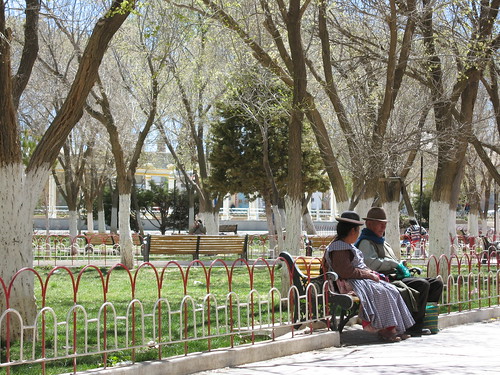
A few hours later we reached the border town of La Quiaca to the tune of more trumpets. It seems like every town has it's own band playing the exact same piece of music. At the border we got stamped out of Argentina and crossed over to join a huge crowd waiting to get into Bolivia. As luck would have it it turned out that the throng were actually waiting to get stamped out of Bolivia so we quickly got processed. Moving our watches back an hour we entered Villazon, the Bolivian border town and immediately sensed we were in a new country. The streets were busy, colourful and the local women were dressed in their traditional frilly full skirts and bowler hats. We had hours to put in before our 3pm bus to Tupiza so we happily sat in the park watching the world go by. At 2pm we decided it might be best to double check that the clocks had definitely gone back an hour. I spotted a well dressed business man marching confidently through the square with a large watch on his forearm. To my horror he announced the correct time was just after three o'clock. We made a mad dash for our bus only to arrive to be told it was only 2pm. Just our luck I managed to pick out the only guy on the Bolivian side of the border with a watch running on Argentinian time. An hour later we finally escaped from Villazon and boarded the bus to Tupiza, almost three hours into the supposedly two hour journey we started to get concerned. We were being thrown around like rag dolls due to the bumps on the unpaved road, we were in the middle a wilderness and it was getting dark and darker. There seemed no way that we'd turn a corner and suddenly enter any kind of a substantial town. Our worries proved unfounded eventually we did turn a corner and arrived in Tupiza a surprising pretty little town. After finding accommodation we set out for some dinner and found The Alamo, a little restaurant filled to the rafters.


The rest of our time in Tupiza was spent trying to find a tour going through the national park and Salar de Uyuni. After a couple of false starts we eventually came across an agency that fitted the bill. We set off with South Africans Dom and Peta and English girl Kelly for our day jeep ride. The "Salar de Uyuni" jeep trip is one of the most worthwhile four days spent in Bolivia.

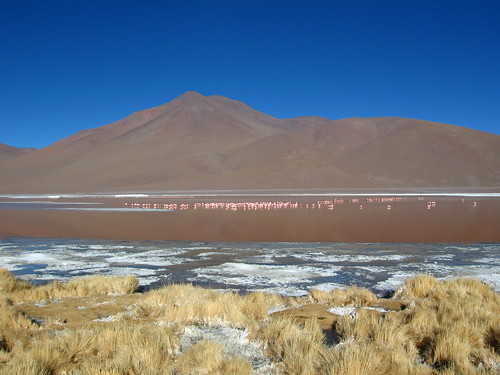
:: One of our most beautiful vistas ::

The salt plains are just one day of it, the other days are spent travelling through very different and diverse scenery, some of the best in Bolivia. Our first day from Tupiza was spent climbing through hills out onto the plateau, stopping for lunch, frisbee throwing with kids in various towns before stopping for the night in a small village. Cards ,namely the game "Benny" was played for hours nightly. The following two days the scenery changed to lagoons of various colours then to flamingo filled lagoons. For some reason as we progressed the flamingos seemed to get less anxious to flee allowing us to get close to them. One of the highlights of the trip was a dip in a thermal pool in the middle of no where - there wasn't a working shower to be seen in the four days so it was probably just as well.

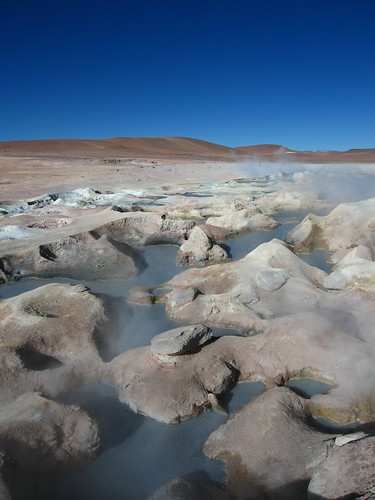
:: Geysers geysering ::

The following day brought smoking volcanoes, steaming geysers and bubbling mud pools.

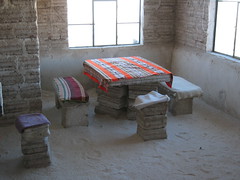
:: Salt Bricks maketh the Salt Hotel ::

Our final night was spent in a Salt Hotel on the edge of Salar de Uyuni. Some of the group went as far as licking the walls to confirm that it was indeed made of salt. Basically the structure was built from salt bricks, the beds, chairs and steps were all carved out of salt a thick layer of salt served as the floor. Our night's stay there was surprisingly comfortable - although it probably had something to do with the fact that it was the only night on the trip where the temperature did not plummet way below zero (we were sleeping around 4000m previously....v.vhigh & cold). We felt sorry for people coming the other way on day one of their trip.


:: Sunrise over the Salt Flats ::

Our final day was spent on the salt flats of Salar de Uyuni. It's an intense landscape, blindingly white salt as far as the eye can see and blue skies. An island populated by cacti in the centre of the Salar de Uyuni offers a good vantage point to marvel it all. After the boys whiled a couple of hours away playing frisbee it was on to the middle of the plain to take some of the customary silly photos. Early that afternoon we reached Uyuni, a total kip of town that only exists because it serves as the jumping off point for tourists to the Salar de Uyuni. We quickly bought a bus ticket for the following morning not willing to chance being stranded for another day in Uyuni.


:: Some goose playing with Dynamite ::

The next stop in Bolivia was the highest city in the world ,Potosi, once one of the largest cities in the Americas. Climbing up the steep hill into town from the bus station you could really feel the altitude. In colonial times Potosi thrived as a city when the Spanish discovered that it's mountain contained vast quantities of silver. It quickly prospered into the Spanish's main coin minting centre. To this day the mines are still excavated, although largely for nickel as the silver quantities are depleted. The mines have a dark history, it's thought that 8 million people have lost their lives. Many agencies bring tourists down the mines; it's one of the most dangerous, scariest experiences you can ever have. Dee visited them last time she was there, so it was Marcus' turn this time. Lets just say, big guy, small spaces, rickety ladders, dusty, dark and dynamite detonating. Seeing the light of day at the surface after 3 hours down the mines was a relief.


:: Potosi ::

Another worthwhile sight in Potosi is the Mint Museum. It still home to many of the impressively large minting machines that churned out Spanish coins for decades. As with every place in Bolivia, Potosi has lots of marching bands, no shortage of ice-cream vendors and lots of chicken restaurants.

And on to Sucre, it used to be the capital of Bolivia before it was moved to La Paz. Sucre is a beautiful old colonial city with impressive white buildings. We ended up staying in a hotel directly in front of the city's market - an endless source of fresh fruit, shakes, olives, cheap dinners and just about anything else you could want right on our doorstep. It was in Sucre that we experience our worst hailstorm ever. We were caught out in the rain and made it as far as the market, we were a mere metres from the entrance into our accommodation when the rain turned to hail forcing us to take cover. The hailstone were so big that they actually hurt when they hit. The only cover available was canvas umbrellas and covers over vendor's stands. At one stage the hail was coming down so hard that it looked like it might breach the canvas.


Everything in the city came to a standstill as torrents of hail fell and flooded the streets. When it finally stopped we had to make a mad dash for the bus station, the water was so deep in the streets that the shoes and socks had to come off to wade through the freezing cold storm water. Thankfully half and hour later we had our tickets in hand, shoes back on again and were standing in the rain beside a mobile pizza oven enjoying a quick dinner before we hopped on the overnight bus to La Paz.


Sitting in a big crater, La Paz is a very bizarre looking city. The centre is at the bottom and all outlying areas sit above it. We arrived early morning and wandered around the city's sights. La Paz had zebra crossings with real zebras helping people across the road... well they were people dressed up in furry zebra costumes! A novelty in any case. We stayed in the tourist area around the witches market. Frequently we were chased down the road by an old lady waving around a llama embryo and other paraphernalia that the witches sell for their spells, or for the tourist's benefit. With time limitations we were anxious to keep going and head for our last stop in Bolivia, Copacabana.


From our accommodations in La Paz we laboured up a long steep hill to the cemetery district to take a minivan to Copacabana it's a standard journey right up the point where you have to cross a lake. Passengers are encouraged to alight the minivan and take a passenger ferry across while the boat is driven onto a rickety wooden pontoon with an engine. Half an hour later all going well (the transport for the buses is seriously dodgy) bus and passengers make it across and the journey continues. Copacabana lies on the shores of Lake Titicaca, it's a touristy town, a place westerners come on their route through to La Paz and a place locals come to for pilgrimages. Good news for the town is it's full of excellent accommodation at very reasonable prices as well as lots of great restaurants.

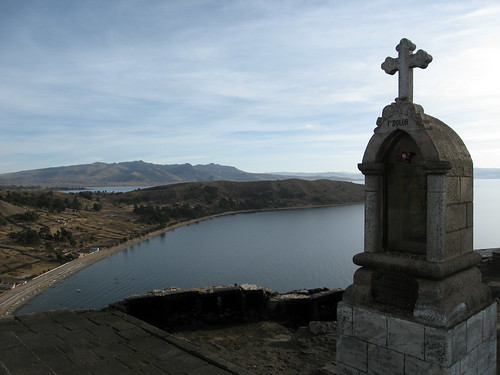
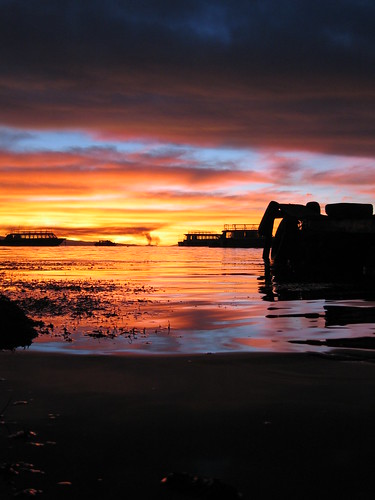
We arrived and enthusiastically threw ourselves into the challenge of climbing the steep hill that overlooks the town. The Stations of the Cross mark the route to the top so it's an easy way to gauge how much effort you still have to make. The views down over Lake Titicaca and Copacabana are incredible. We made it up in time for a beautiful sunset. Later that night we ventured to the local market for dinner, we found a little old lady making up alpaca and potato skewers. They tasted exactly the same as Chinese skewers it was uncanny. One of the most outstanding elements of Copacabana were its sunsets. Every evening from the beach the most spectacular sunsets would be unveiled as the sun sunk below the fishing boats.


:: Stunning sunset over Lake Titicaca ::

Regretfully we opted for a day excursion to the Isla de Sol, as the legend goes it's the birthplace of the Inca civilisations. Nowadays the island seems to just try to cash in on tourists offering little in return. A manufactured trek i.e. a path from one end of the island has been constructed, you pay to enter the town in north, pay to walk along the path and then pay to come off the path and down the steps back to the boat. There's an obsession with tickets which detracts from the whole experience. A one off fee that would demonstrate a collective preservation of the island would be more ideal rather than constantly bugging visitors for more money and handing out ticket after ticket.


Read more...

Monday, December 15, 2008

Bring on South America...


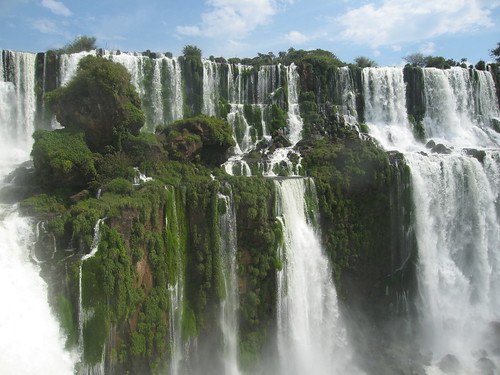
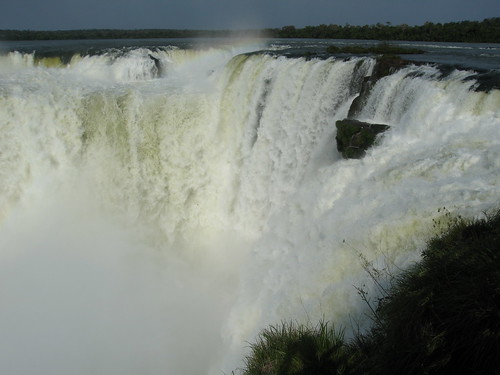
:: Minor falls at Iguazu ::

:: Warning - the following post may disturb Vegetarian readers ::

Setting off for South America was like starting afresh again. Since setting out two years ago we can trace on a map our whole contiguous route over land from Dubrovnik all the way to Cairo. Flying to Argentina was our first deflection from this overland route - a necessary one, but a new beginning to another land journey. The first challenge was getting to grips with the language, the most worrying discovery was that the phase book didn't contain the phrase "medium, rare" an absolute must when ordering that happened daily in the weeks that followed.

There are two ways of getting from Buenos Aires airport to the city, the airport shuttle bus (1 hr) and the local 86 bus (2.5 hours). With time on our side we chose the latter and were treated to a very long ride through every two horse town on the way into the city. Choosing this route soon made us acutely aware of just how sprawling a capital Buenos Aires, is looking out the bus window we wondered would we ever get to the centre. When you do get to the centre the traffic is atrocious, the main bus station, business district and an unbelievably busy container port all lie in close proximity to each other creating a recipe for disaster. It can take an hour to move just a couple of kilometers.


:: Tango on our doorstep ::

We stayed in the San Telmo area, an artsy quarter with lots of funky cafes, restaurants and antique shops not far from the centre. Over the weekend the whole area came alive with street markets, music and tango dancing on the street. Despite very cold temperatures dancers braved the chill in their scanty little tango dresses - and yes it is true they do just dance in the streets in Buenos Aires. Another interesting area we visited was the gritty old Bocca barrio famous for it's multicoloured buildings and old town vibe.


:: Recoleta Cemetery ::

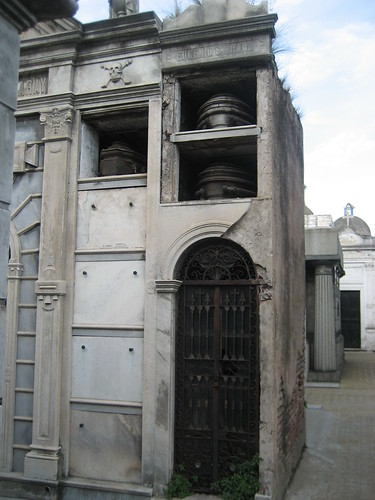
No trip to Buenos Aires is complete without visiting it's unusual cemetery. Some of it's famous inhabitants include Eva Peron (Evita) however the real draw is the cemetery itself. Most of the coffins are in full view in family crypts. The crypts themselves are in various states of repair, some brand new other is disrepair with ceilings crumbing down in on top of the coffins. It's a very weird place and even more wacky to know that you could technically reach through the bars and touch a coffin. It's definitely not the kind of place you want to be around when it gets dark.


:: Need say no more... ::

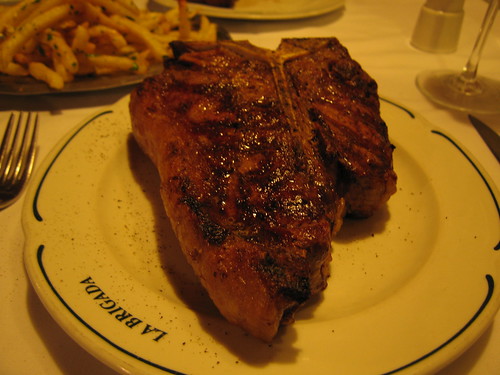
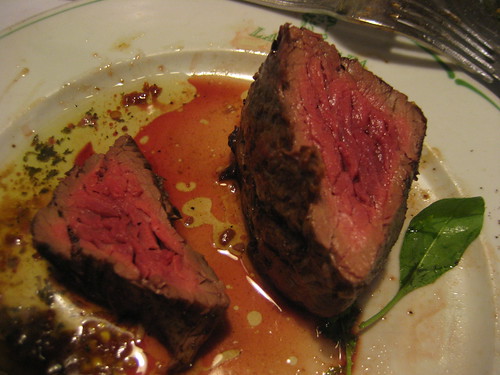
Meat, meat, meat is the mainstay of the Argentinian diet. Parilla restaurants are on every corner, usually with big windows full of different cuts of meat grilling away, street food consists of choripans (sausages) it's definitely a place where you struggle to eat anything else. Our main activity in Buenos Aires was rating steak and red wine restaurants and boy that was an enviable task. Writing this looking back makes my mouth water. We had some of our finest steaks, huge 500g cooked to perfection offerings. One restaurant boasted that it's steaks were so tender and well cooked that you could cut your steak with a spoon - incidentally that was La Brigada and it was one of the best steaks we've ever had. As to be expected red wine is also and area where Argentina excels. For a couple of dollars you can pick up a great one on a supermarket shelf. It's an affordable drink that naturally accompanies dinner rather than an extravagance.

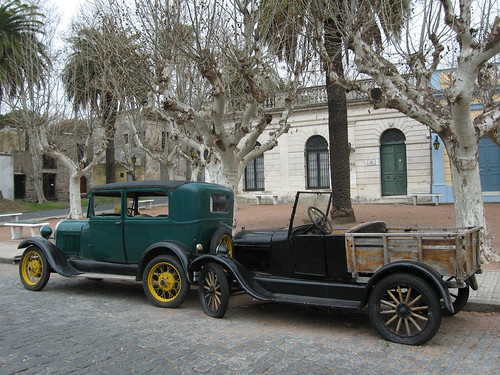
From Buenos Aires we toyed with the idea of heading south towards Patagonia. Plummeting temperatures, insufficient winter clothes and past experience however steered our decision to go north towards the warmer regions. Our next hop was a ferry ride over to Uruguay and to Colonia, a picture perfect seaside town. Colonia looks like a movie set, old buildings housing smart restaurants, mossy cobbled streets, vintage cars abandoned here and there and a ruin or two thrown in for good measure. You can easily see it all walking around it for a couple of hours - or race around in a ridiculous buggy vehicle like many of the tourists did the day we were there.


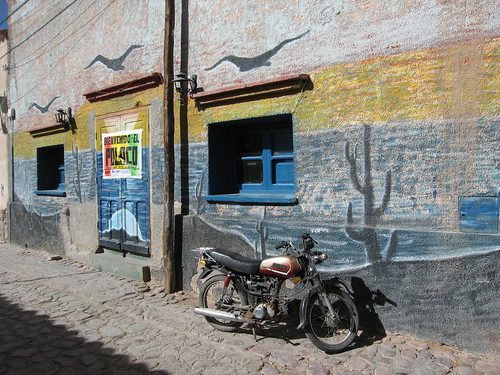
:: Colonia streetscape ::


Montevideo, the capital of Uruguay was next on the itinerary. To be honest our first impressions of the place was a bit "grey and boring". Everything seemed a bit drab, mind you the search for accommodation wasn't going too well and we'd just purchased a hotdog from a street vendor complete with hair, perhaps that had something to do with our outlook. With a bed found and the sun out, the city became all the more attractive. After a bit of wandering we found the nice buildings and beautiful old square. The real charm of Montevideo lies in the area near the port. At present it's the run down largely derelict side of town but surprisingly there are streets and streets of art deco buildings. Our bets are this area will be Montevideo prime real estate of the future.


:: mmmm... lunch ::

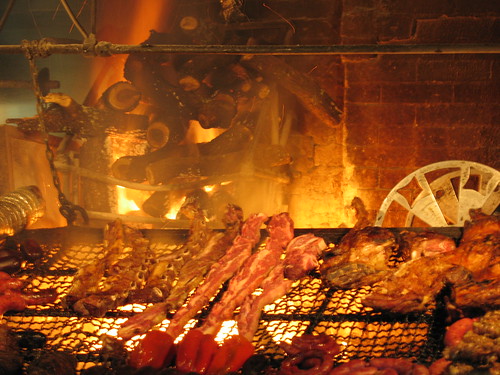
Lunchtime means meat time... so it was off to the Mercado, a huge factory like building with a smoking chimney containing about twenty different restaurants all serving huge hunks of meat. You walk around grill after grill taking a look at what they've got - usually every conceivable part of the animal. Then you choose an establishment, sit down at a bench and tuck in.

Cities in Argentina are connected by a well serviced network of luxury buses. There's no such thing as the cheap rickety option of getting between two points, actually there's no choice, it's luxury expensive bus or no bus. Bus costs can be frighteningly high, we looked in horror at the cost of getting a few hours up the road and had to remind ourselves that the bus would not only have a soft seat but also the decadence of windows. At the start it felt like out and out flashpacking - far too swish. All the same there are a lot of unnecessary comforts that are no doubt factored significantly into the cost like hot meals and Styrofoam cups of wine.

We bussed north through Argentina to the city of Rosario its claim to fame being the birthplace of Che Guevara. From there it was on to the sleepy town of Posadas, we arrived early on a Sunday morning to find everything closed for the day. Our hotel owner an 87 year old woman pointed us in the direction of a "Tenedor Libre" (all you can eat meat joint). After Sunday lunch we took a stroll along the river front along with the entire population of Posadas along with their mugs and flasks. This naturally brings me to Yerba Mate, the drink of Argentinians and the national pasttime. Everyone and I mean everyone walks around with their own cup made from a gourd, filled to the brim with Yerba and a metal straw to suck it through. In this part of the world it's a social activity and a way of life. To us it was a bizarre and cumbersome addiction, not only do you need to carry a mug and a straw but you need an entire flask of water to keep your cup topped up for the day.


:: The falls ::

We made a big push north to get to Puerto Iguazu in time for Marcus's birthday. We arrived off a long long bus ride to a welcome wave of tropical heat. At last a chance to retire the thermals and wooly socks! Puerto Iguazu is a big tourist hub and jumping off point to Iguazu Falls which sit on the border of Argentina and Brazil. Usually towns so close to big card draws are not worth hanging around but Puerto Iguazu was an exception. The town itself has a lot of local colour one of the highlights was a market specialising in delicacies. In the evenings local people would pull up and share a selection of olives, cheeses and salamis over a cold beer. A highly civilised afternoon activity.


:: " Don't mind if I do " ::

Of course everyone is in Iguazu for one reason and one reason only - to see the magnificent Iguazu waterfalls. They do not disappoint, they are literally jawdroppingly amazing. We visited from the Argentinean side where a park of pathways designed to have minimum impact on the environment leads you to different vistas and aspects of the wide cascade of waterfalls. Iguazu Falls is a series of different waterfalls so climbing the walkways took us over and under the falls. For the thrill seeker you can take a boat ride straight under the falls - thus simulating a torrential rain shower. We found the best view was from the island close to the falls. We left the most impressive of the falls, the Devil's Mouth as the last stop of the day. To get there you take a train and walk out along a platform over a wide river several hundred metres wide. The scary thing is that the river flows innocuously not giving you any indication of the huge violent drop off around the corner. Standing watching an awesome amount of water careering over the edge of Devil's Mouth was an spectacular sight.

Sadly my Granny passed away so we found ourselves back in Ireland for her funeral. Our return flight brought us all the way back to Buenos Aires this time we didn't hang around. We stopped long enough for a steak dinner before hopping on an afternoon-overnight bus to Salta in the North of Argentina. Salta is a beautiful city with a pretty little town square, lovely old buildings and plenty of stunning scenery. We spent a day recovering from the bus journey and soaking up the relaxed atmosphere before before departing for "wild west" Humacuaca further north towards the Bolivian border.


Humacuaca is one of the quirkiest of our stops, it's a tiny picturesque town in the middle of dusty no where. Really all it's got is an old train yard, a bus station, cute cobbled streets, a grassy town square and clock tower. Picture dust, tumbleweed and the odd cactus. The clock tower is unique; at twelve o'clock daily a life size monk emerges from a cuckoo clock, makes the sign of the cross and disappears until the following day. His daily appearance is pretty much the highlight of the town. We chanced giving it a miss in favour of catching the 8am bus to the Bolivian border a few hours north. A marching band trumpeting in the street at the crack of dawn had us up early anyhow.

:: Gratuitous Steak shot ::

Read more...

Bring on South America...


:: Minor falls at Iguazu ::

:: Warning - the following post may disturb Vegetarian readers ::

Setting off for South America was like starting afresh again. Since setting out two years ago we can trace on a map our whole contiguous route over land from Dubrovnik all the way to Cairo. Flying to Argentina was our first deflection from this overland route - a necessary one, but a new beginning to another land journey. The first challenge was getting to grips with the language, the most worrying discovery was that the phase book didn't contain the phrase "medium, rare" an absolute must when ordering that happened daily in the weeks that followed.

There are two ways of getting from Buenos Aires airport to the city, the airport shuttle bus (1 hr) and the local 86 bus (2.5 hours). With time on our side we chose the latter and were treated to a very long ride through every two horse town on the way into the city. Choosing this route soon made us acutely aware of just how sprawling a capital Buenos Aires, is looking out the bus window we wondered would we ever get to the centre. When you do get to the centre the traffic is atrocious, the main bus station, business district and an unbelievably busy container port all lie in close proximity to each other creating a recipe for disaster. It can take an hour to move just a couple of kilometers.


:: Tango on our doorstep ::

We stayed in the San Telmo area, an artsy quarter with lots of funky cafes, restaurants and antique shops not far from the centre. Over the weekend the whole area came alive with street markets, music and tango dancing on the street. Despite very cold temperatures dancers braved the chill in their scanty little tango dresses - and yes it is true they do just dance in the streets in Buenos Aires. Another interesting area we visited was the gritty old Bocca barrio famous for it's multicoloured buildings and old town vibe.


:: Recoleta Cemetery ::

No trip to Buenos Aires is complete without visiting it's unusual cemetery. Some of it's famous inhabitants include Eva Peron (Evita) however the real draw is the cemetery itself. Most of the coffins are in full view in family crypts. The crypts themselves are in various states of repair, some brand new other is disrepair with ceilings crumbing down in on top of the coffins. It's a very weird place and even more wacky to know that you could technically reach through the bars and touch a coffin. It's definitely not the kind of place you want to be around when it gets dark.


:: Need say no more... ::

Meat, meat, meat is the mainstay of the Argentinian diet. Parilla restaurants are on every corner, usually with big windows full of different cuts of meat grilling away, street food consists of choripans (sausages) it's definitely a place where you struggle to eat anything else. Our main activity in Buenos Aires was rating steak and red wine restaurants and boy that was an enviable task. Writing this looking back makes my mouth water. We had some of our finest steaks, huge 500g cooked to perfection offerings. One restaurant boasted that it's steaks were so tender and well cooked that you could cut your steak with a spoon - incidentally that was La Brigada and it was one of the best steaks we've ever had. As to be expected red wine is also and area where Argentina excels. For a couple of dollars you can pick up a great one on a supermarket shelf. It's an affordable drink that naturally accompanies dinner rather than an extravagance.

From Buenos Aires we toyed with the idea of heading south towards Patagonia. Plummeting temperatures, insufficient winter clothes and past experience however steered our decision to go north towards the warmer regions. Our next hop was a ferry ride over to Uruguay and to Colonia, a picture perfect seaside town. Colonia looks like a movie set, old buildings housing smart restaurants, mossy cobbled streets, vintage cars abandoned here and there and a ruin or two thrown in for good measure. You can easily see it all walking around it for a couple of hours - or race around in a ridiculous buggy vehicle like many of the tourists did the day we were there.


:: Colonia streetscape ::


Montevideo, the capital of Uruguay was next on the itinerary. To be honest our first impressions of the place was a bit "grey and boring". Everything seemed a bit drab, mind you the search for accommodation wasn't going too well and we'd just purchased a hotdog from a street vendor complete with hair, perhaps that had something to do with our outlook. With a bed found and the sun out, the city became all the more attractive. After a bit of wandering we found the nice buildings and beautiful old square. The real charm of Montevideo lies in the area near the port. At present it's the run down largely derelict side of town but surprisingly there are streets and streets of art deco buildings. Our bets are this area will be Montevideo prime real estate of the future.


:: mmmm... lunch ::

Lunchtime means meat time... so it was off to the Mercado, a huge factory like building with a smoking chimney containing about twenty different restaurants all serving huge hunks of meat. You walk around grill after grill taking a look at what they've got - usually every conceivable part of the animal. Then you choose an establishment, sit down at a bench and tuck in.

Cities in Argentina are connected by a well serviced network of luxury buses. There's no such thing as the cheap rickety option of getting between two points, actually there's no choice, it's luxury expensive bus or no bus. Bus costs can be frighteningly high, we looked in horror at the cost of getting a few hours up the road and had to remind ourselves that the bus would not only have a soft seat but also the decadence of windows. At the start it felt like out and out flashpacking - far too swish. All the same there are a lot of unnecessary comforts that are no doubt factored significantly into the cost like hot meals and Styrofoam cups of wine.

We bussed north through Argentina to the city of Rosario its claim to fame being the birthplace of Che Guevara. From there it was on to the sleepy town of Posadas, we arrived early on a Sunday morning to find everything closed for the day. Our hotel owner an 87 year old woman pointed us in the direction of a "Tenedor Libre" (all you can eat meat joint). After Sunday lunch we took a stroll along the river front along with the entire population of Posadas along with their mugs and flasks. This naturally brings me to Yerba Mate, the drink of Argentinians and the national pasttime. Everyone and I mean everyone walks around with their own cup made from a gourd, filled to the brim with Yerba and a metal straw to suck it through. In this part of the world it's a social activity and a way of life. To us it was a bizarre and cumbersome addiction, not only do you need to carry a mug and a straw but you need an entire flask of water to keep your cup topped up for the day.


:: The falls ::

We made a big push north to get to Puerto Iguazu in time for Marcus's birthday. We arrived off a long long bus ride to a welcome wave of tropical heat. At last a chance to retire the thermals and wooly socks! Puerto Iguazu is a big tourist hub and jumping off point to Iguazu Falls which sit on the border of Argentina and Brazil. Usually towns so close to big card draws are not worth hanging around but Puerto Iguazu was an exception. The town itself has a lot of local colour one of the highlights was a market specialising in delicacies. In the evenings local people would pull up and share a selection of olives, cheeses and salamis over a cold beer. A highly civilised afternoon activity.


:: " Don't mind if I do " ::

Of course everyone is in Iguazu for one reason and one reason only - to see the magnificent Iguazu waterfalls. They do not disappoint, they are literally jawdroppingly amazing. We visited from the Argentinean side where a park of pathways designed to have minimum impact on the environment leads you to different vistas and aspects of the wide cascade of waterfalls. Iguazu Falls is a series of different waterfalls so climbing the walkways took us over and under the falls. For the thrill seeker you can take a boat ride straight under the falls - thus simulating a torrential rain shower. We found the best view was from the island close to the falls. We left the most impressive of the falls, the Devil's Mouth as the last stop of the day. To get there you take a train and walk out along a platform over a wide river several hundred metres wide. The scary thing is that the river flows innocuously not giving you any indication of the huge violent drop off around the corner. Standing watching an awesome amount of water careering over the edge of Devil's Mouth was an spectacular sight.

Sadly my Granny passed away so we found ourselves back in Ireland for her funeral. Our return flight brought us all the way back to Buenos Aires this time we didn't hang around. We stopped long enough for a steak dinner before hopping on an afternoon-overnight bus to Salta in the North of Argentina. Salta is a beautiful city with a pretty little town square, lovely old buildings and plenty of stunning scenery. We spent a day recovering from the bus journey and soaking up the relaxed atmosphere before before departing for "wild west" Humacuaca further north towards the Bolivian border.


Humacuaca is one of the quirkiest of our stops, it's a tiny picturesque town in the middle of dusty no where. Really all it's got is an old train yard, a bus station, cute cobbled streets, a grassy town square and clock tower. Picture dust, tumbleweed and the odd cactus. The clock tower is unique; at twelve o'clock daily a life size monk emerges from a cuckoo clock, makes the sign of the cross and disappears until the following day. His daily appearance is pretty much the highlight of the town. We chanced giving it a miss in favour of catching the 8am bus to the Bolivian border a few hours north. A marching band trumpeting in the street at the crack of dawn had us up early anyhow.


:: Gratuitous Steak shot ::

Read more...

Monday, November 03, 2008

Egypt - Hot, Wet and Tasty


:: Luxor ::

And onto Egypt... bring it on! We were ready to meet the very renowned worst of the world's touts, tricksters and scams artists.

Our first stop was the backpacking diving mecca of Dahab. We intended staying a few days but that quickly stretched to over a week. It was a great opportunity to get a few dives under our belts. So for our stay in Dahab we threw ourselves into a pretty rigourous diving schedule. From a recreational diving perspective Dahab and the Red Sea have some fantastic dive sites full of tropical fish and coral ranging in difficulty. All the dives are shore dives so the full geared walk to the water can be demanding. An added bonus is the affordability of the dive packages (6 dives for 100 euros) and Dahab itself is a pretty little cheap and cheerful town full of guesthouses and restaurants that suit every budget.

Dahab is famous for it's Blue Hole a "bottomless" hole revered by technical and freestyle divers. You don't have to be around Dahab for long before you hear all the stories of bodies being recovered from the bottom of the hole after technical dives have gone badly wrong with fatal results. (youtube for more - including some beautiful freediving efforts here)

We spent the early mornings diving and afternoons hanging out in Bishi Bishi guesthouse enjoying cheap beers and great food with Dave. We had a great opportunity to take a side trip and dive the Thistlegorm wreck lying off the coast of Sharm El Shiek. As wreck sites go it was a facinating dive, the World War 2 ship went down and still lies at the bottom complete of its cargo - motorbikes, motorcars, tires, boots, cannonballs etc. As Always a picture tells a 1000 words so here is a little video of someones dive on the Thistlegorm to give you a visual of how cool it is.


You can even swim through captian's quarters. It's an interesting wreck although very challenging due to currents and groups of mixed ability divers. We got a lucky day where there wern't too many boats from Sharm El Sheik so it wasn't as busy as it could have been. We took a customary two hour recovery period in Sharm El Shiek before heading back over the mountains to Dahab. It was certainly long enough to see Sharm for the horrible touristy resort it has become and everyone was delighted to get back to little-ol Dahab. After saying goodbye to our diving buddy Dave we decided it was time to hit the road again.


:: Dave vs Hookah ::

The next stop was Suez which turned out to be a lot more hassle than it was worth. Arriving in the late afternoon we had enormously difficulty finding a bed for the night. Every single hotel was full to capacity. By the time we found the very last room in the city it was too dark to go and see the Suez canal up close - we saw the ships gliding through the desert from afar. We departed the following morning early in an attempt to get to Luxor in daylight hours. Getting from Suez to Luxor was a huge challenge, we managed to find a bus going to a place 30 km from Luxor. We arrived and found the terminus where minivans left every hour or so for Luxor. The drivers agreed to take us but only if we paid three times the fare. Their reason being that we'd (tourists) would just be hassle going through the checkpoints. The scene turned nasty and the men got openly hostile and changed their stance to point blank refusing to take us anywhere. Cue tears from me (half staged, half genuine!) followed by Marcus addressing the crowd saying "are you all happy now, you've made my wife cry?". After lots of guilty looks and shuffling around they finally agreed to take us. There was a stage pretears where we thought we'd be stuck there indefinitely. As it happens there was zero hassle at any of the checkpoints and an hour or so later we were dropped on the outskirts of Luxor.


:: Luxor Temple ::

Luxor is hassle, hassle, hassle. The taxis, the shopkeepers and the horse and cart men constantly tout their business and aggresively follow you around waiting for you to finally give in and hand your money over. We found the key to an easy life was to get on a bike, the lesson is only the walkers get solicitated. So luckily we saw the whole of Luxor unhassled, in 47 degree heat, on a couple of rickity rented bikes. On one very long hot day we set out for the Valley of the Kings, as we neared the entrance gates the security guards cheered us on. We were definitely the novelty of the day, most of the tourists were in big airconditioned coaches. We'd a great day panting around the ancient tombs. Most of the time we had the tombs to ourselves but where we didn't it was ok as we mostly overlapped with Russian tour groups, they tend to visit things at such a rate that they create a breeze that benefits everyone else.


:: Luxor ::

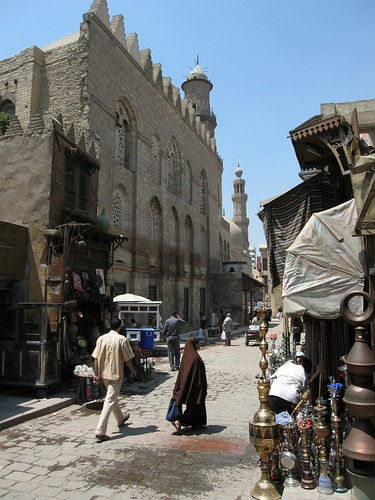
Our final stop was the capital, Cairo, a city not half as hectic as we expected. Taking it's chaotic traffic out of the equation, Cairo is a very civilised city with a fantastic vibe. It ticked all the boxes for us, fantastic food, interesting streets, old buildings and lots of different diverse areas. We found a great room with a balcony overlooking a quiet street right in the centre of the city and settled in very quickly. Everything was on our doorstep including the amazing Egyptian museum - well worth the visit to see the treasures of the country and of course the infamous gold mask of King Tut.


:: Muslim area in Cairo ::

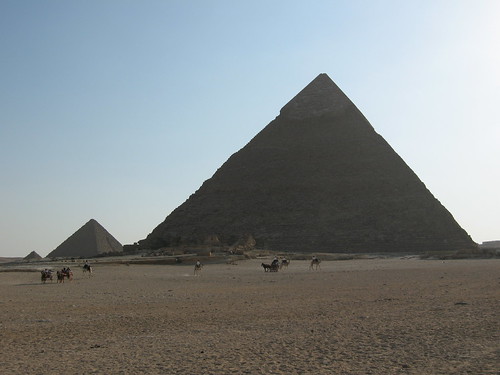
Our trip to the pyramids didn't quite pan out as expected. We decided to go in the afternoon, hoping to avoid the tour groups. When we got there the place was desserted save for a handful of tourists. A further surprise was that we were only offered two camel rides and one postcard. Declination was met with respect and no further bothering - to our utter amazement/disappointment. We found ourselves asking "aren't these guys supposed to be the most hardnosed touts on the planet? Why aren't they hassling us? What's wrong with our money?". So our experience of the Pyramids was a tranquil one, no hassle, no crowds we wandered around the site, watched the sunset and practically closed to the place down. A very memorable afternoon.


:: Simply Stunning::

From there our next stop was Dublin for Katherine and Niall's wedding, another welcome break from the road to a soft bed and fridge full of unusual things such as cheddar cheese and rashers!

Our time in Ireland coincided with two sad family deaths. My Aunty Mary, herself a well travelled person and avid reader of our blog, sadly passed away after a long illness. A few short weeks later my Granny also died after reaching the remarkable age of 95 years. Losing these two people fundamental in my family's life was a reminder of how important it is to make the most of the time we've got in this world. For us, this translates into completing what we started - seeing our trip through to the end and enjoying the opportunity that we've been given.


Read more...

Egypt - Hot, Wet and Tasty


:: Luxor ::

And onto Egypt... bring it on! We were ready to meet the very renowned worst of the world's touts, tricksters and scams artists.

Our first stop was the backpacking diving mecca of Dahab. We intended staying a few days but that quickly stretched to over a week. It was a great opportunity to get a few dives under our belts. So for our stay in Dahab we threw ourselves into a pretty rigourous diving schedule. From a recreational diving perspective Dahab and the Red Sea have some fantastic dive sites full of tropical fish and coral ranging in difficulty. All the dives are shore dives so the full geared walk to the water can be demanding. An added bonus is the affordability of the dive packages (6 dives for 100 euros) and Dahab itself is a pretty little cheap and cheerful town full of guesthouses and restaurants that suit every budget.

Dahab is famous for it's Blue Hole a "bottomless" hole revered by technical and freestyle divers. You don't have to be around Dahab for long before you hear all the stories of bodies being recovered from the bottom of the hole after technical dives have gone badly wrong with fatal results. (youtube for more - including some beautiful freediving efforts here)

We spent the early mornings diving and afternoons hanging out in Bishi Bishi guesthouse enjoying cheap beers and great food with Dave. We had a great opportunity to take a side trip and dive the Thistlegorm wreck lying off the coast of Sharm El Shiek. As wreck sites go it was a facinating dive, the World War 2 ship went down and still lies at the bottom complete of its cargo - motorbikes, motorcars, tires, boots, cannonballs etc. As Always a picture tells a 1000 words so here is a little video of someones dive on the Thistlegorm to give you a visual of how cool it is.


You can even swim through captian's quarters. It's an interesting wreck although very challenging due to currents and groups of mixed ability divers. We got a lucky day where there wern't too many boats from Sharm El Sheik so it wasn't as busy as it could have been. We took a customary two hour recovery period in Sharm El Shiek before heading back over the mountains to Dahab. It was certainly long enough to see Sharm for the horrible touristy resort it has become and everyone was delighted to get back to little-ol Dahab. After saying goodbye to our diving buddy Dave we decided it was time to hit the road again.


:: Dave vs Hookah ::

The next stop was Suez which turned out to be a lot more hassle than it was worth. Arriving in the late afternoon we had enormously difficulty finding a bed for the night. Every single hotel was full to capacity. By the time we found the very last room in the city it was too dark to go and see the Suez canal up close - we saw the ships gliding through the desert from afar. We departed the following morning early in an attempt to get to Luxor in daylight hours. Getting from Suez to Luxor was a huge challenge, we managed to find a bus going to a place 30 km from Luxor. We arrived and found the terminus where minivans left every hour or so for Luxor. The drivers agreed to take us but only if we paid three times the fare. Their reason being that we'd (tourists) would just be hassle going through the checkpoints. The scene turned nasty and the men got openly hostile and changed their stance to point blank refusing to take us anywhere. Cue tears from me (half staged, half genuine!) followed by Marcus addressing the crowd saying "are you all happy now, you've made my wife cry?". After lots of guilty looks and shuffling around they finally agreed to take us. There was a stage pretears where we thought we'd be stuck there indefinitely. As it happens there was zero hassle at any of the checkpoints and an hour or so later we were dropped on the outskirts of Luxor.


:: Luxor Temple ::

Luxor is hassle, hassle, hassle. The taxis, the shopkeepers and the horse and cart men constantly tout their business and aggresively follow you around waiting for you to finally give in and hand your money over. We found the key to an easy life was to get on a bike, the lesson is only the walkers get solicitated. So luckily we saw the whole of Luxor unhassled, in 47 degree heat, on a couple of rickity rented bikes. On one very long hot day we set out for the Valley of the Kings, as we neared the entrance gates the security guards cheered us on. We were definitely the novelty of the day, most of the tourists were in big airconditioned coaches. We'd a great day panting around the ancient tombs. Most of the time we had the tombs to ourselves but where we didn't it was ok as we mostly overlapped with Russian tour groups, they tend to visit things at such a rate that they create a breeze that benefits everyone else.


:: Luxor ::

Our final stop was the capital, Cairo, a city not half as hectic as we expected. Taking it's chaotic traffic out of the equation, Cairo is a very civilised city with a fantastic vibe. It ticked all the boxes for us, fantastic food, interesting streets, old buildings and lots of different diverse areas. We found a great room with a balcony overlooking a quiet street right in the centre of the city and settled in very quickly. Everything was on our doorstep including the amazing Egyptian museum - well worth the visit to see the treasures of the country and of course the infamous gold mask of King Tut.


:: Muslim area in Cairo ::

Our trip to the pyramids didn't quite pan out as expected. We decided to go in the afternoon, hoping to avoid the tour groups. When we got there the place was desserted save for a handful of tourists. A further surprise was that we were only offered two camel rides and one postcard. Declination was met with respect and no further bothering - to our utter amazement/disappointment. We found ourselves asking "aren't these guys supposed to be the most hardnosed touts on the planet? Why aren't they hassling us? What's wrong with our money?". So our experience of the Pyramids was a tranquil one, no hassle, no crowds we wandered around the site, watched the sunset and practically closed to the place down. A very memorable afternoon.


:: Simply Stunning::

From there our next stop was Dublin for Katherine and Niall's wedding, another welcome break from the road to a soft bed and fridge full of unusual things such as cheddar cheese and rashers!

Our time in Ireland coincided with two sad family deaths. My Aunty Mary, herself a well travelled person and avid reader of our blog, sadly passed away after a long illness. A few short weeks later my Granny also died after reaching the remarkable age of 95 years. Losing these two people fundamental in my family's life was a reminder of how important it is to make the most of the time we've got in this world. For us, this translates into completing what we started - seeing our trip through to the end and enjoying the opportunity that we've been given.


Read more...

Jordanian um....well.. read it and see


:: Wow - Petra made it all worth it ::

::Rant Ahead - be warned::
What goes up must come down; after an amazing time in Syria we slipped over the border into Jordan and into what turned out to be our least favourite country in all our travels. I'll start by stressing that the things that irked us most were typical "independent traveller" gripes and also bad experiences that were specific to us. We were rubbed up the wrong way once too many times and our tolerance to see the country though properly, quickly waned, so we made the decision to power through the must-sees and out of Jordan as quick as possible. Admittedly this meant we did a whistlestop fly-through bouyant on negativity and didn't leave Jordan or Jordians much room for redemption. That being said we've covered a lot of ground over the past two years, always unearthing the good in places and we class ourselves as people who are easy to please. Disappointingly, this demonstates to us that our gripes weren't totally futile and unfounded.

High on the list of annoyances was the rip-off attitude towards tourists. We've experienced this in some shape or form in every place we've ever visited. When it comes to a premium Magnum icecream, teeshirt, Diet Coke, or a chilled bottle of water at the gate of the Taj Mahal, inflated prices can be tolerated, in fact they're expected. For basic items necessary to survive such as bread and water, bought far from the gates of a tourist attractions, there can be no such mandate. The difference in Jordan was that it was done in the absolute extreme. The price of a bottle of water (necessary to fend off dehydration in 40 degree plus heat) could differ by as much as two US dollars between shops for the same bottle. It was a constant battle to find water that wasn't being sold at tourist inflated extortionist prices. We went into a busy bakery one morning where locals were in buying huge bags of bread. The price for 10 rolls for them turned out to be the price quoted to us for one roll. When challenged the owner simply indicated that "You´re not Jordanian". It would have been cheaper for us to eat in a restaurant. Exasperated it was on to a small restaurant for a takeaway falafel, no prices on the menu, when we asked no one was quite sure what the price was (please note this was there core business) eventually a pathetically scanty falafel appeared. It was so ridiculous it was funny. We normally don't eat in white table cloth touristy restaurants preferring instead to eat where ever locals are. In Jordan we quickly began to realise that if you wanted to experience the real Jordan, away from the bus tours and pizza restaurants then it was an uphill battle the whole way.

Getting around Jordan proved to be just as annoying. Arriving to take a bus without a prebooked ticket from an agency or hotel was frowned upon, someone somewhere had lost out on commission. We got a bus early one morning only to be told that as we hadn't booked seats we might be thrown off. That's fair enough only the buses were far from full. Lots of locals turned up to take the same service. Getting the honest price on a bus ticket was another barrel of laughs, nobody knew the proper price of a ticket, not a local, not a hotel, not the tourist office, it was a lucky dip.

So our limited dealings with Jordians were fraught and met with out and out rudeness. Everyone was quick on the defensive, moaned about how hard life was and generally came across as a nation coping with a miserable lot. Blatent bitching and moaning about people, or things or prices of this and that, left most travellers we spent time around with a gutful of the whingers. It was at that point we decided we'd had enough. Our efforts to get along and enjoy the country were getting nowhere fast and we were only getting more and more disillusioned and annoyed.


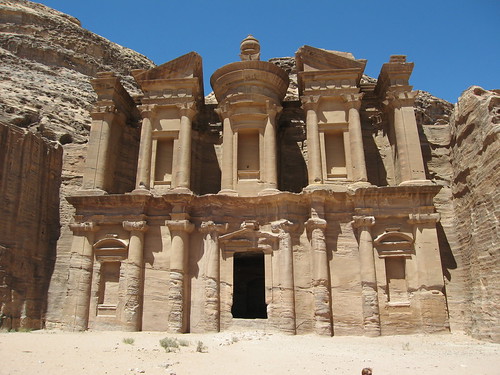
: The Monastery ::

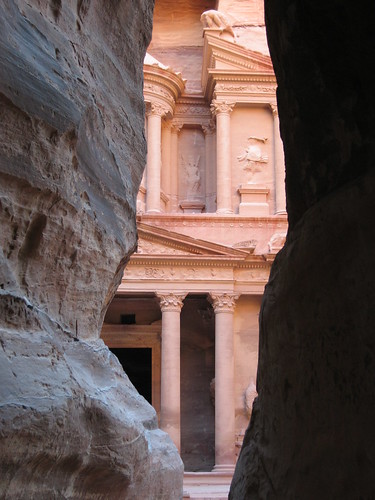
On a positive side we were absolutely blown away by Petra. As you walk through the long narrow canyon leading up to the Treasury builing you think you're fully prepared to see the famous sight, the first glimpse you catch however total exceeds expectations. The highlight of a long hot day at Petra was without a doubt climbing up to the monastery which magestically stands on the top of a hill.


:: The Monastery ::

Amusingly around Petra there's a collective whistling or humming of the Indiana Jones theme song. At one stage we heard the theme song being belted out enthuasistically only to round the corner to the site of a family coming the other way on mules. Thoroughly enjoying the moment was the dad leading the troupe, hat in hand, singing away.... on a small mule, his feet were inches from dragging through the sand. The mule was slowly meandering it's way along the road oblivous to his oversized riders ambitions or reinacting the final scene of the "Lost Chalice" movie.


:: First Sight ::

Our next stop was a night in the desert at Wadi rum. After picking our tent for the night we set off on a long 15km walk across the hot desert sands towards a rock that loomed on the horizon. Arriving before the midday heat struck we decided to take a nap in a shady canyon before starting the return journey. We got comfortable at the canyon and ended up staying there all day watching other tourist groups coming and going. In fact at one point I woke from a snooze to the scary sight of a couple of cameras in my face - Japanese tourists. One thing we learnt that day was how hard it is to gauge distances in the desert. You see a something in the distance and set off for it but it can take hours to actually reach it. As dusk was falling we finally made it back to our little tent. A good day out in the desert but after dragging ourselves through heavy sand all day we were glad to get back to the tarmacked road.


:: Desert Sands ::

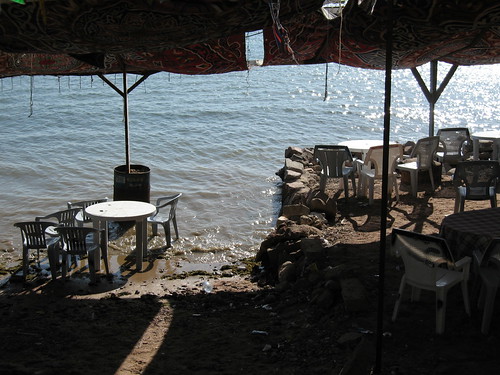
The final port of call in Jordan was the seaside city of Aquba, arriving one day before a big holiday we found that everywhere had a room available but for one night only. Easy decision made to spend a night, take a look around and catch a morning ferry across to Egypt. Aquba turned out to be fairly unremarkable, a standard touristy town full of tacky souvenir shops and restaurants. It's beach was a little strange, the entire strip was one empty drinks restaurant after another all covered their frontage in tables and chairs, there wasn't an inch of sand to be seen. Even weirder was the awning that covered the whole beach. Whatever concept was in play just didn't work, as the tide came in tables and chairs kind of floated unattractively in murky water.


:: Sea View ? ::


The following morning we set off for the port to catch the ferry to Egypt. Generally the word on the street was to get to the ferry terminal 2 hours in advance of a departure. We arrived for our 10am departure an hour and a half in advance - no thanks to our bus overshooting the drop off point and only grinding to a halt and throwing us out on the highway after we pointed questioningly back a few large ferries we'd zoomed past. Panting up to the window Marcus asked for two tickets to Egypt, the seller reponded by wagging his finger in a schoolmaster fashion and tapping his watch three times before generally ignoring him. Marcus tapped the window and said "Can you sell me a ticket the ferry doesn't leave for one and a half hours?" the guy shrugged noncommitedly. After a lot of pointless to-ing and fro-ing the ticket man decided he'd made enough of a scene and finally backed down on the ferry company's intolerance for tardiness in the punctuality department. Ironically the boat departed two hours late. There is a point to making people turn up two hours before departure - a total chaotic system exists to check in, get stamped out of Jordan, buy a stamp for this, get a receipt for that and finally pay for everything at the other end of the building. We didn't even get to experience the full fiasco, when we got to the gate of the ferry there was a large crowd (on dry land) pushing forward to the boarding gate in a frantic queue - it was as if there was a ship sinking and there weren't enough lifeboats. An uniformed guy with a large gun spotted us looking on bewilderment at the scene and motioned us forward and through the boarding gate. During the two hour delay, five hour crossing and three hour wait for them to open the doors and release us onto dry land we had plenty of time to make friends with Dave, a fellow bewildered passenger with who we kicked on and had some great adventures with...in the next episode.


Read more...

Jordanian um....well.. read it and see


:: Wow - Petra made it all worth it ::

::Rant Ahead - be warned::
What goes up must come down; after an amazing time in Syria we slipped over the border into Jordan and into what turned out to be our least favourite country in all our travels. I'll start by stressing that the things that irked us most were typical "independent traveller" gripes and also bad experiences that were specific to us. We were rubbed up the wrong way once too many times and our tolerance to see the country though properly, quickly waned, so we made the decision to power through the must-sees and out of Jordan as quick as possible. Admittedly this meant we did a whistlestop fly-through bouyant on negativity and didn't leave Jordan or Jordians much room for redemption. That being said we've covered a lot of ground over the past two years, always unearthing the good in places and we class ourselves as people who are easy to please. Disappointingly, this demonstates to us that our gripes weren't totally futile and unfounded.

High on the list of annoyances was the rip-off attitude towards tourists. We've experienced this in some shape or form in every place we've ever visited. When it comes to a premium Magnum icecream, teeshirt, Diet Coke, or a chilled bottle of water at the gate of the Taj Mahal, inflated prices can be tolerated, in fact they're expected. For basic items necessary to survive such as bread and water, bought far from the gates of a tourist attractions, there can be no such mandate. The difference in Jordan was that it was done in the absolute extreme. The price of a bottle of water (necessary to fend off dehydration in 40 degree plus heat) could differ by as much as two US dollars between shops for the same bottle. It was a constant battle to find water that wasn't being sold at tourist inflated extortionist prices. We went into a busy bakery one morning where locals were in buying huge bags of bread. The price for 10 rolls for them turned out to be the price quoted to us for one roll. When challenged the owner simply indicated that "You´re not Jordanian". It would have been cheaper for us to eat in a restaurant. Exasperated it was on to a small restaurant for a takeaway falafel, no prices on the menu, when we asked no one was quite sure what the price was (please note this was there core business) eventually a pathetically scanty falafel appeared. It was so ridiculous it was funny. We normally don't eat in white table cloth touristy restaurants preferring instead to eat where ever locals are. In Jordan we quickly began to realise that if you wanted to experience the real Jordan, away from the bus tours and pizza restaurants then it was an uphill battle the whole way.

Getting around Jordan proved to be just as annoying. Arriving to take a bus without a prebooked ticket from an agency or hotel was frowned upon, someone somewhere had lost out on commission. We got a bus early one morning only to be told that as we hadn't booked seats we might be thrown off. That's fair enough only the buses were far from full. Lots of locals turned up to take the same service. Getting the honest price on a bus ticket was another barrel of laughs, nobody knew the proper price of a ticket, not a local, not a hotel, not the tourist office, it was a lucky dip.

So our limited dealings with Jordians were fraught and met with out and out rudeness. Everyone was quick on the defensive, moaned about how hard life was and generally came across as a nation coping with a miserable lot. Blatent bitching and moaning about people, or things or prices of this and that, left most travellers we spent time around with a gutful of the whingers. It was at that point we decided we'd had enough. Our efforts to get along and enjoy the country were getting nowhere fast and we were only getting more and more disillusioned and annoyed.


: The Monastery ::

On a positive side we were absolutely blown away by Petra. As you walk through the long narrow canyon leading up to the Treasury builing you think you're fully prepared to see the famous sight, the first glimpse you catch however total exceeds expectations. The highlight of a long hot day at Petra was without a doubt climbing up to the monastery which magestically stands on the top of a hill.


:: The Monastery ::

Amusingly around Petra there's a collective whistling or humming of the Indiana Jones theme song. At one stage we heard the theme song being belted out enthuasistically only to round the corner to the site of a family coming the other way on mules. Thoroughly enjoying the moment was the dad leading the troupe, hat in hand, singing away.... on a small mule, his feet were inches from dragging through the sand. The mule was slowly meandering it's way along the road oblivous to his oversized riders ambitions or reinacting the final scene of the "Lost Chalice" movie.


:: First Sight ::

Our next stop was a night in the desert at Wadi rum. After picking our tent for the night we set off on a long 15km walk across the hot desert sands towards a rock that loomed on the horizon. Arriving before the midday heat struck we decided to take a nap in a shady canyon before starting the return journey. We got comfortable at the canyon and ended up staying there all day watching other tourist groups coming and going. In fact at one point I woke from a snooze to the scary sight of a couple of cameras in my face - Japanese tourists. One thing we learnt that day was how hard it is to gauge distances in the desert. You see a something in the distance and set off for it but it can take hours to actually reach it. As dusk was falling we finally made it back to our little tent. A good day out in the desert but after dragging ourselves through heavy sand all day we were glad to get back to the tarmacked road.


:: Desert Sands ::

The final port of call in Jordan was the seaside city of Aquba, arriving one day before a big holiday we found that everywhere had a room available but for one night only. Easy decision made to spend a night, take a look around and catch a morning ferry across to Egypt. Aquba turned out to be fairly unremarkable, a standard touristy town full of tacky souvenir shops and restaurants. It's beach was a little strange, the entire strip was one empty drinks restaurant after another all covered their frontage in tables and chairs, there wasn't an inch of sand to be seen. Even weirder was the awning that covered the whole beach. Whatever concept was in play just didn't work, as the tide came in tables and chairs kind of floated unattractively in murky water.


:: Sea View ? ::


The following morning we set off for the port to catch the ferry to Egypt. Generally the word on the street was to get to the ferry terminal 2 hours in advance of a departure. We arrived for our 10am departure an hour and a half in advance - no thanks to our bus overshooting the drop off point and only grinding to a halt and throwing us out on the highway after we pointed questioningly back a few large ferries we'd zoomed past. Panting up to the window Marcus asked for two tickets to Egypt, the seller reponded by wagging his finger in a schoolmaster fashion and tapping his watch three times before generally ignoring him. Marcus tapped the window and said "Can you sell me a ticket the ferry doesn't leave for one and a half hours?" the guy shrugged noncommitedly. After a lot of pointless to-ing and fro-ing the ticket man decided he'd made enough of a scene and finally backed down on the ferry company's intolerance for tardiness in the punctuality department. Ironically the boat departed two hours late. There is a point to making people turn up two hours before departure - a total chaotic system exists to check in, get stamped out of Jordan, buy a stamp for this, get a receipt for that and finally pay for everything at the other end of the building. We didn't even get to experience the full fiasco, when we got to the gate of the ferry there was a large crowd (on dry land) pushing forward to the boarding gate in a frantic queue - it was as if there was a ship sinking and there weren't enough lifeboats. An uniformed guy with a large gun spotted us looking on bewilderment at the scene and motioned us forward and through the boarding gate. During the two hour delay, five hour crossing and three hour wait for them to open the doors and release us onto dry land we had plenty of time to make friends with Dave, a fellow bewildered passenger with who we kicked on and had some great adventures with...in the next episode.


Read more...

  © Blogger templates The Professional Template by Ourblogtemplates.com 2008

Back to TOP